Just a quick note that I will be restarting this blog this month. The format is the same. New posts on Mondays. Lots of good stuff coming up: Posts on Thomas Olde Heuvelt's Hex, a continuation of the Foundation series, an assortment of quick notes on books, and maybe some new recipes.
Wednesday, September 23, 2020

Saturday, June 13, 2020
Reading, Writing, Fatigue, and Times of Quarantine
Last week I finished reading James S.A. Corey’s Cibola Burn, the fourth book in The Expanse series. Originally, I had envisioned reading and writing about a number of different sci-fi series as a part of this blog. So far, it had worked and for the last couple of years I have read a lot of great books that I have been meaning to get to. There have also been a few not-so-great books in there, too, but I don’t mind that so much.
The Corey book was good. It was an entertaining read and continues to develop the series on a good trajectory. But when it came time to begin writing about it, I just couldn’t seem to make myself do it. I have generally been pretty good about motivating myself to write since graduate school, but this just wasn’t happening.
There are a couple of reasons that I just couldn’t seem to get myself over the hump and write it. The first reason is just time. The longer the span of time between finishing reading and beginning writing, the more I put it off. I was losing little bits of plot and details about the characters. I write most of these posts from memory and with minimal notes. I will occasionally draft little bits while reading or note particular passages, but I don’t get overly studious about it.
I write most of these posts within a day or two of finishing a book while it is still relatively fresh and while it is still on my mind.
I hadn’t gotten a chance to write about this because my job has been working massive amounts of overtime for the last 3 months since the Covid 19 quarantine started. I work in a warehouse in inventory control. My job is not super physical but I am on my feet all day. It can have physical elements to it at times. As our working days increased in length, I just didn’t have it in me to come home, shift gears to think about writing, and still have time to spend with my wife, eat, and have time to relax. I just ran out of time. This meant that the things that I would normally do during the week after work would get pushed to the weekends and the time I would normally spend reading and writing then dried up as well.
In fact, this is the first bout of sustained writing that I have done in nearly that whole three months.
The reason, then, that this all caught up to me is that I had been writing a backlog of posts for about the last year. At one point, I had about 6 months’ worth of posts pre-written and scheduled for a weekly update. Just this month I ran through my backlog and am up to current.
This made me question the future of this blog. Did I really need to post weekly? It was my own schedule and I can really do what I want. No one really reads this anyway, so what was the difference?
I still don't have an answer to these questions. There is a part of me that wants to chuck this whole blog and concentrate what time I do get to another project. But then again, I am loathe to give up on something that I have, essentially, been doing just for myself all along. So I miss a post here and there. No one cares. I can pick up whenever I want.
I think that I will keep going. Maybe I can focus on shorter posts, or maybe I can find a different way to carve out some extra time. I do like thinking and writing about books.
Here is the point of all of this: work is fatiguing, even when it is work that we want to do, and particularly when it is work that we do not want to do. I can’t take a break from my day job right now but I may be able to take a break from this for a little to recharge and refocus. I do have other projects that I want to work on, or maybe I can just let things run fallow for a spell before trying to take anything on.
Monday, June 1, 2020
Foundation, Part 5: Foundation's Edge
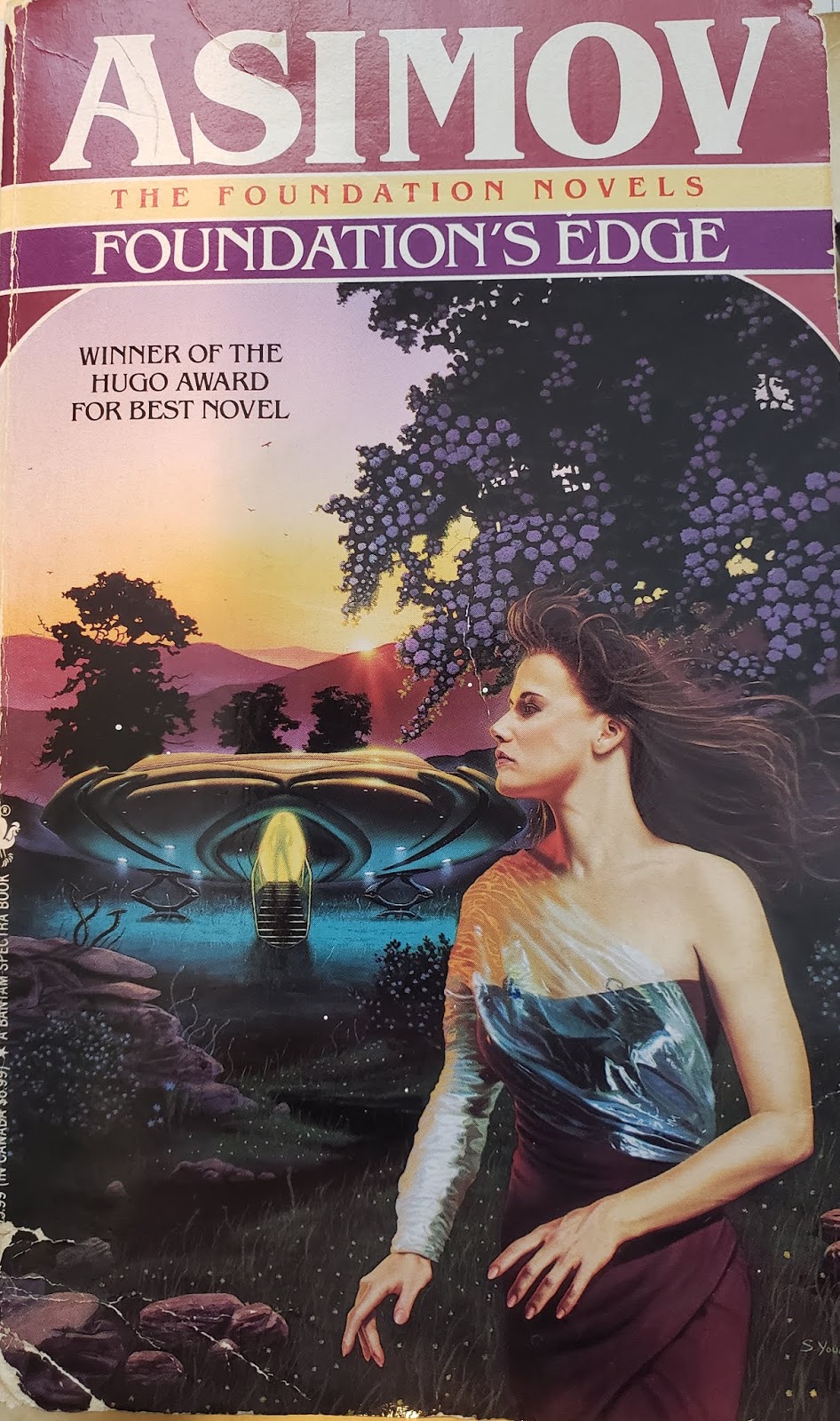
Foundation’s Edge is the fourth novel in Isaac Asimov’s Foundation series. This book is set 500 years after the events of the first book, at what should be the halfway point between Seldon’s time and the beginning of the Second Galactic Empire.
To briefly recap the previous books in the series, the first novel introduces the science of psychohistory by which Hari Seldon predicts the downfall of the Galactic Empire and the following dark age. Seldon plots a course of future history that will shorten the dark age from 30,000 years to just 1,000 and which will henceforth be known as the “Seldon Plan.” Seldon establishes the Foundation to carry out his plan and help usher humanity toward the next stage of empire and, presumably, back to a preferable way of living.
In the following novels, the Empire slides into decline as the Foundation takes on greater importance. The Empire, of course, lashes out in its dying but is unable to fight against the superior Foundation. Along the way, with Seldon now long dead, the Foundation and the rest of humanity learn of a Second Foundation that Seldon had built at the same time, but on the other edge of the galaxy.
For some reason the Foundation believes that the Second Foundation is a threat to the Seldon Plan (despite the fact that Seldon built both, with the secret Second Foundation as a kind of insurance against the destruction or failure of the Foundation). Equally unaccountably, the Foundation comes to believe that since they are built upon the principles of science, the Second Foundation must be built upon principles of emotion.
At some point there enters a space clown nick-named The Mule who can control people’s emotions. Some Foundationers think that he is from the Second Foundation, but he isn’t and he almost unravels the whole Seldon Plan before the real Second Foundation swoops in to save it and defeat the Mule.
Now we get into the current novel. In Foundation’s Edge, the two Foundations are still in conflict, though the Second Foundation has gone back into secrecy and the tensions are more covert. Asimov mirrors intrigue on both sides of the conflict. Both Foundations feature a strong central council with an upstart member who wants to strike out to save the Seldon Plan, though they are moving in different directions, of course. Both Foundations are tracking each other and the whole plot involves double-agents who may be triple-agents and the thing ends up being more complicated than it needs to be for where it is going. But where it is going is actually pretty good.
I’m not going to spend too much time disentangling the whole plot here because it really is better to just read it and wade through the whole thing. There are two narrative points that I want to hit before moving on to some other analysis.
First is the plot line to find humanity’s origins. In this world, Earth is not a known, inhabited planet and humanity’s origins are shrouded in prehistory. This plot point picks up a thread from the first novel that I have written about elsewhere. Golan Trevize, the Foundation’s young upstart is sent off on a mission to find Earth as a cover for his real mission to find the Second Foundation. He is paired up with Janov Pelorat, a historian who specializes in Earth mythology. This plot line goes in some unexpected directions and actually ends up serving the overarching plot in a satisfying way. Pelorat is genuinely taken with the idea of finding Earth and ends up drumming up a lot of enthusiasm for the topic despite most people’s indifference to the question of the origin of the species. Pelorat forces others to question why the known, inhabited planets have species that are all so similar to each other and why there is so little biodiversity on any one given planet. He uses this line of questioning to introduce his thesis that Earth must have been a lot like what we know it to actually be like. Asimov builds in a nice use of the scientific method to get Pelorat to make the right logical jumps.
The second plot point is the connection that Asimov makes in this novel between the world of Foundation and his robot novels. Rather than finding Earth, Pelorat and Trevize find a planet that was first colonized by humans from Earth with the help of their robots. Up until this point there have been no robots in The Foundation series, and this book offers an explanation. Again, there is some satisfaction in reading through the steps to get there, so I won’t go into too much detail. Suffice to say that Asimov puts humanity through its paces and provides some philosophical exploration of the boundary between freedom and security.
One of the major questions that arises throughout the novel is central to the encyclopedic project in itself. That is, what happens when future generations no longer want to participate in the projects we give them? The whole concept of the encyclopedia is predicated upon the idea that scholars of the present will be able to communicate with scholars of the future, to provide them a basis from which to begin their own work. It is an encapsulation of both the great hope and the massive arrogance of the whole Enlightenment. It does not ask whether future scholars may share our same passions, or even acknowledge our own assumptions. More than once in the novel, the question is put to the Seldon Plan. Asimov never explicitly compare the plan to fate or raises questions of freedom of choice, but this problem parallels the questions raised around the role of robots protecting humanity and humanity’s desire to break free and live on its own. This was perhaps the most philosophical of the Foundation novels so far because of the way that these elements come together.
This was also my favorite of the Foundation novels that I have read so far. As far as I have been able to tell. The original trilogy were all originally written as short stories that were stitched together into a novel-length narrative and that this is the first one to be conceived as a novel. The difference shows. The character development is much better and the entire narrative is more empathic because of it. The different elements also come together much better. In Asimov’s earlier novels, there were constant narrative threads left unresolved and interesting ideas left unexplored. This novel shows better Asimov’s talents. The first novels worked because of the strength of the ideas and fell apart on the weaknesses of plot and character development. This narrative has the space to explore these threads and to bring them together.
Monday, May 25, 2020
The Invisible Man
 In my quest to seek out and read more classic sci-fi, I recently read H.G. Wells' The Invisible Man. The novel follows the last days of Griffin, a scientist who has discovered the means to turn himself invisible after he has fled London for the countryside to find a way to make himself visible again. He tries to enlist the help of Kemp, a former classmate of his, who is horrified to learn of Griffin's wanton violence in the city. Although Griffin wants to reverse the invisibility process and return to human society, he also revels in the advantages of invisibility and promises a "reign of terror" if he does not get the help he desires.
This novel continues a tradition of gothic sci-fi first pioneered by Mary Shelley in Frankenstein. In fact, this is one book that helps to establish the mad scientist figure. Like Victor Frankenstein and Herbert West (of H.P. Lovecraft's "Herbert West - Reanimator"), Griffin is a lone scientist practicing on the edges of established science. Frankenstein and West both become obsessed with the dividing line between life and death while Griffin is interested in optics. All three share a mania that pushes them to stretch their science beyond their own understanding that eventually leads to their own downfall. All three of these tales may be interpreted as cautionary tales against obsession and, particularly, against the darker turn that science can take, though none of them seem to fault scientific curiosity itself but rather the odd-duck impulses of the solo practitioner.
Wells' narrative approach to this novel is equally interesting. He opens the novel with a mysterious stranger, covered head to toe, arriving at an inn in Iping, a small village. He demands privacy in his rooms, which only causes the landlords to take a greater interest in him. What is peculiar about this introduction is that Wells seems to want to draw the reader into the mystery of who this man is and why he keeps himself covered. This is a good narrative hook in itself, but is a bit ruined by the title of the novel. Nevertheless, the action quickly escalates as Griffin faces exposure (as it were).
It isn't until Griffin finds Kemp that Wells backtracks and narrates, via Griffin's perspective, the process that he used to turn himself invisible. In this re-telling, Griffin also relates the difficulties of invisibility despite its perceived advantages. Just a few examples being his need to remain nude, inability to carry anything to avoid detection, and a need to avoid weather conditions common in England (rain, mist, snow). Because of these restrictions, Griffin informs Kemp, it is impossible to use his invisibility for its most obvious purpose, theft. Instead, Griffin tells him, it is perfect for murder since he can dodge attacks and approach from any angle.
At one point Kemp advises Griffin to throw himself onto the mercy of the country and allow himself to be cared for and examined by the scientific community. In this way, Kemp seems to offer a remedy for all of those mad scientists of the world: return to the institutions. This would also seem to be a way to re-direct the purpose of scientific investigation away from individual gain or hopes of glory back to that of the common good in adherence to the best intentions of the Enlightenment project. Of course Wells does not make this explicit in the novel (nor do Lovecraft or Shelley, for that matter).
I knew the basic outline of The Invisible Man before sitting down to read it but I was surprised by the discussions between Griffin and Kemp in this light. Wells firmly grasps the double-edged nature of science in this way. He both saw its great potential and the dangers lurking in it. This is a theme that he will continue to develop in some of his lesser-known work and that I will probably return to at some point in another post.
Monday, May 18, 2020
Hey Ho

So I'll just drop this in here for what it's worth. Read the book if you are inclined, it is worth the time.
The rest of this (hopefully) short post is going to be about the band and their music.
At this point, I think it is impossible to overstate the influence that the Ramones had on both punk rock and on rock and roll in general. The sound, the look, the song structure, the attitude, all of it has been copied over and over with varying degrees of success. I first started listening to the Ramones when I was in high school, around the same time that I began discovering a lot of other punk rock. They weren't the first band I listened to, or even the one that I listened to the most, but they were always in rotation in our group of friends. But my first contact with the Ramones goes back even further. In fact, I don't remember a time when I actually first discovered or first heard the Ramones because they seemed to just always be around. I remember joking with my brother about this weird band that might all be brothers because they all had the same last name, knowing nothing else about them. I might have been 10 or 11 at the time. Once I started getting into punk rock, they were a group like MC5, the Stooges, and others that were the originators of the sound. But, this was the early 1990s and there were also a lot of imitators that we heard as well. This is all to say that now, after having listened to the band's music for 25+ years, I have a different appreciation for it. When I was young I was drawn to the Ramones for the simplicity and the raw energy of their music. This is still a draw, but I think that there is a kind of genius in the sincerity of this straight-forward rock style. The Ramones were never overtly political but the message that they conveyed through their style took on a greater significance than the simplicity of the lyrics would suggest. I realize that there is probably not a lot I can say about this band that is new, but a lot of their early songs defined a sort of ironic punk detachment that has run through the whole scene. Their stance and image was cool and it let you know that they didn't care whether you liked them or not. The Ramones were just the Ramones and you had to deal with it on their terms, or not.
I did get to see the Ramones play live one time. I was maybe 15 or 16 years old and my brother took me to see a show in Cleveland. The headliner was White Zombie and the Ramones were opening. Joey leaned out over the crowd, his foot up on the monitor in front of him. The song I remember the most from the set is "Pet Sematary." The set was fast and they powered through a number of their classic songs.
Thinking back on that day, I am glad that I had the chance to see them. Growing up where I did, I got to see a lot of bands play, and I still see a decent amount. This makes me glad. It reminds me that there is still a collective way to absorb art with like-minded folks. I think this is a lot of what the Ramones did for pop music and for punk.
Monday, May 11, 2020
Two novels about Mars
 Back when I was in college, I experienced an aspect of reading that I think is common for English majors. That is, while taking multiple courses it becomes necessary to keep up reading multiple books at the same time. I think a lot of English majors, like me, were probably also reading novels for themselves outside of their coursework. From time to time this would lead to tandem reading of novels that seem to speak to each other in interesting ways. It is a neat way to find parallels between literature that, on the face, may seem to have little in common. It is also a great place to begin asking questions about the works and challenging accepted readings of them.
This intersection occurred for me recently when I happened to find myself reading both The Martian Chronicles by Ray Bradbury and The Martian by Andy Weir at about the same time. See, I have a whole bookshelf packed with novels I want to get to, both books that are new to me and ones I want to reread. I also have a backlog of ebooks in my phone that I read as chance happens. I had read The Martian Chronicles years ago and wanted to revisit it and had The Martian in my phone waiting for me. What strikes me about this tandem reading is how different these books are in approach and style. Bradbury's Mars bears little similarity to the actual planet. Instead, he uses Mars as a way to explore human interaction and the human urge to explore, colonize, and conquer. Earthlings in The Martian Chronicles don't come off very good. Bradbury creates a microcosm of Earth on Mars in which he can poke at different aspects of humanity. There is a broad disregard for native Martian life and culture and many of humanities worst traits are immediately rebuilt in what some in the book see as a second chance to recreate a new social structure. Bradbury's view of Mars and humanity veers from sentimental to apocalyptic and back. It is a book that seems to want to ask questions about human nature and what we will be like when we reach past our own planet. The answer keeps coming back that we are just going to keep being the same.
The outlook in The Martian is pretty different. The majority of this book is narrated as Mark Watney's journal. Watney is stranded on Mars, having been left behind as the rest of the crew of the Ares mission leave under emergency circumstances. The captain and crew believe that Watney is dead after being speared by a broken communications antenna. The rest of the novel details Watney's attempts to stay alive on Mars without support and NASA's attempts to get him supplies and/or rescue him. This novel works to highlight what is best in humanity. A mission of exploration becomes an opportunity to showcase human ingenuity and self-sacrifice. Weir's naturalistic presentation seems more grounded in contemporary science.
These books demonstrate the different modes of sci-fi. It doesn't really matter that Bradbury's Mars is so fantastic and unrealistic because he, ultimately, works to write about human attitudes toward science and each other more than about realistic space travel. And even if Weir's novel seems truer to what we know about space exploration, it is equally speculative and hopeful in forwarding this scientific project. These two books, like a lot of sci-fi, end up being more about the people and the ideas that they find important. Bradbury warns about human nature and the way that even well-intentioned projects can lead to disaster while Weir presents a modern castaway romance that cheerleads supposedly dispassionate science.
Monday, May 4, 2020
The New Campus Novel
 I only learned about Geoff Cebula's self-published novel Adjunct because of a headline for an article from The Chronicle of Higher Education decrying the new academic novel that dared to deflate academics in a new way and point out the tenuous position of adjunct faculty. The article itself was behind a paywall so I was only able to read the first couple of paragraphs. In that span, the article called these new novels "disgusting" and probably went on to make some point about higher education that most adjuncts would find ridiculous.
In any case, it was enough to make me want to read this book, and I am glad I had the chance to do so. To begin, the novel identifies a lot of problems for contingent faculty in academia. (For those readers unfamiliar with this phenomenon, a brief summary: institutions of higher education like to hire on teachers contracted by the class. Since this is contract work, the school only pays for courses taught, offers no guarantee of future work, provides no benefits, and provides virtually no path to permanent or full-time work. Many adjunct faculty members string together a living by teaching at multiple schools and overloading their schedules because the pay is not very good. Many also provide a lot of free work to the school and in the name of scholarship in the hopes of gaining a tenure-track job. The outlook is bleak for many of these teachers and it poses a real problem in higher education that I won't get fully into here.) The narrative itself centers around disappearing adjunct faculty and a sinister plot to repurpose them. I don't want to get too far into the plot here because it gets a little shaggy and it really isn't the most interesting part of the book.
What is interesting is the way that Cebula chooses to present these problems. The main character, Elena, is an adjunct faculty member who accepts more responsibility than she should in the hopes of continued employment while also struggling with her feelings of inadequacy. Elena worries that the work that she does is not enough or that her scholarship is not up to par. These worries are reinforced by her own institution by cutting the very major in which she teaches while loading her up with more work. Elena also keeps comparing her own fortunes against those of her peers. The novel is funny and depressing at the same time and it speaks very directly to those who have had a similar experience in higher ed. The novel works mainly because it is plain-spoken about the difficulties faced by adjunct faculty. Many educators have felt mis-placed competition with peers and feelings of inadequacy for not succeeding to the level of their own expectations.
Elena's central dilemma is not the mystery at the center of the novel but is about her vocation. She questions her ability to stick out another year of searching for jobs and continuing to write and research versus giving up on the dream and finding work outside of academics. This is a familiar problem for many who earn doctoral degrees.
So, I wasn't able to read the full article because I don't have a subscription to The Chronicle so I don't know what the author had to say about this book. It started off looking like a defense of the adjunct-ridden system, but it may have veered off. I have decided to be charitable and give it the benefit of the doubt because there are a lot of publications out there that are very willing to ignore the experience of adjuncts and erase the problem in academia. Books like this one are central to reform in the academic world and need to be boosted a bit more. The problems highlighted in the book are real and are a threat to the broader system of education in addition to the workers that it demeans and undervalues.
Subscribe to:
Posts (Atom)