Friday, October 23, 2020

Out James-ing Henry

 Over the last week or so, my wife and I watched the new Netflix series The Haunting of Bly Manner. Or rather, we watched 7ish of the 9 episodes.

This show started off well as an adaptation of Henry James' excellent novella The Turn of the Screw, but it goes off the rails and undoes a lot of what makes James' story spooky and interesting.

From the very opening, the source material is obvious for anyone familiar with James' novella as a group of people sit around a fire telling ghost stories. One participant opens the story exactly the way that James does, even invoking James' phrase, “turn of the screw.” So far so good.

Once the frame narrative is out of the way and the main narrative begins, we see that it is a period piece, set in the 1980s. This is fine and it doesn't end up being as much of a big deal as it seems at first. The set up is good and works well for a tv format. All is good until the story really starts to get rolling. I have four main complaints about the whole show that eventually led to us deciding to throw in the towel and give up on finishing it.

First, (oh yeah, I am gonna spoil the fuck outta this dumb show) everything is supernatural. All of the careful ambiguity that James builds into his novella, all of the psychological tension and unreliability that he slowly reveals over the course of the story is gone. At the end of the novella, the reader is not really sure what happened. It is possible that the governess made everything up or went mad or maybe there is a ghost. There is sufficient evidence to support each of these readings of the novella. This is actually James' gift. He makes the interpretation of the story track back onto the reader's personality and predilections. Here, not so much. There are ghosts.

Second, the characters talk so goddam much. The precious, precocious Flora utters the sickly phrase “perfectly splendid” to no end throughout the series. Yes, this is meant to be a character tic for a child repeating a phrase she had heard an adult she admires speak. Well enough for what it is, but it keeps coming back. The gardener Jamie is a tough-as-nails misanthrope who promises Dani (the governess in the novella) that people aren't worth knowing because they always let you down. And she repeats this again and again. She makes the longest speeches to others around her trying to demonstrate how much she doesn't need them when not talking to them at all would be a much more efficient and effective way of doing the same. The other characters make similarly long-winded speeches. I like talky movies and shows, but this seemed to me to be directorial distrust of the viewer. It seemed to me that someone decided that I was too dumb to get what was going on and needed to have the whole thing spoon-fed to me. Thus:

Third, subtext is made text. Did Quint and Miss Jessel have an affair in The Turn of the Screw? Did Quint abuse Miles? Did the governess actually see any of this? Are the kids making shit up? No solid answers are provided for any of these by James. Again, my position is that this is what makes the ghost story great and this is a staple of Gothic literature. We don't know. And not knowing is better because it is scarier. The Haunting of Bly Manor not only answers all of these questions, it provides even more backstory and answers even more questions than the reader/viewer ever really had.

And finally, the whole thing is too damn long. This would have been a fantastic 4 or 5-part show if it had continued in the same vein as the first few episodes. Too much unneeded backstory, too much re-narration (several plot segments are replayed multiple times with slight variations), too much talking. This could have been so much tighter and it would have generated so much tension.

To conclude, this show had a lot of promise from the first few episodes and I really was hoping for an adaptation that would do justice to the source material. But this just can't deliver. I could perhaps see past some of the above points if it weren't for the fact that the explanation at the end just doesn't hold together. There is a whole plot in which dead Quint kills Miss Jessel and then ropes the kids into becoming vessels for the dead souls of these lovers and it just couldn't keep me. The explanation just felt needlessly convoluted and tacked on. So watch the first few episodes and keep it up until you can't take it anymore. That's what I did. Or you can watch and enjoy the whole thing like it seems a lot of other folks did.

Monday, October 19, 2020

Hex by Thomas Olde Heuvelt

Thomas Olde Heuvelt's Hex is probably one of my favorite reads of the year so far.  I have always enjoyed reading horror novels since I was young, and this one fits in the with the best of them.  Before getting into a summary of the novel, I will say that one of the standout elements of this novel is the fact that Olde Heuvelt plants this novel in a contemporary America in a way that feels very real.  Some horror novels can edge a little too far into fantasy and set their narratives in a rarified world that doesn't really track onto the world that we know.  For me, this tends to take away from the impact that good horror can have.  Hex is powerful because the world Olde Heuvelt creates feels so much like our own and the characters in it react in ways that we could imagine ourselves reacting.


Hex is about small town Black Spring that is haunted by a witch.  The witch's name is Katherine Van Wyler and she has a long history.  She was persecuted and forced to kill one of her own children in her own time, 350 years before the opening of the novel, and she has been a presence in the town ever since.  Katherine shows up periodically in different parts of the town and she walks familiar paths.  At one point in her history, the people of the town wrapped her in chains and stitched her eyes and mouth closed.  For the most part, the people of Black Spring have learned to live with the witch, putting up with her presence and hiding her form outsiders.  The only real effect that she has is to keep people of Black Spring trapped in the town.  Once a person takes up residence i the town they are unable to leave for more than a week or so before they begin to feel deep depression and suicidal urges until they return to town.

The main thing that sets Hex apart from other supernatural horror novels is the way that the townspeople deal with Katherine.  HEX is the name of an agency the town council set up to deal with Katherine.  Their job is to liaise with West Point (which in this world exists at least partially to monitor Katherine) and to track her movements through town with the goal of keeping her a secret from the rest of the world.  So this is all pretty good so far, but what sets this novel apart is the integration of technology, and this is what makes is a truly contemporary horror story.  HEX uses an app that allows people to log Katherine's appearances so that they can track her.  HEX has also installed security cameras throughout town.  The town maintains constant surveillance over the which, and also monitors the internet usage of its citizens to keep them from leaking information of Katherine's existence to the outside world.

Steve Grant and his family play a central role in the novel.  Unbeknownst to Steve, his son Tyler has started a website called Open Your Eyes that aims to expose Katherine's existence to the world.  Tyler believes that the town can break their spell by "coming out" to the world about their haunting.  Using his GoPro to film evidence, Tyler and his friends begin a series of "experiments" involving Katherine.  They try to disrupt her normal paths to see if she will vary her routine and they record her whispering to see if it will affect people living outside of town.  Katherine's whispering is generally regarded to be curses that drive people to suicide.

The boys' interactions are all banned by HEX and violate the Emergency Decree that outlines the town's dealings with Katherine, which basically boils down to not messing with her and keeping her a secret.  Tyler is careful to out of town to upload his videos and blog posts to avoid detection by HEX.  However, one of his group of friends starts pushing the boundaries of what the group does.  he begins to get aggressive with Katherine, siccing a dog on her and leading the rest of the group, excluding Tyler and his friend Lawrence, to stoning her.  This, of course, sets off a whole string of escalating events that have dire results for the boys and eventually the town.

So there are really two major things going on in the novel that I really like.  The first is that the characters are very well drawn and they react to their town and the events unfolding in realistic ways.  All of the characters, Katherine included, act in keeping with well-defined motivations and their actions are generally understandable, even when they to the wrong thing.  Both Steve's and Tyler's characters are dynamic, likable, and well-rounded.  Even Katherine, a character who does not speak and seems to have limited agency, has strong motivations and a defined character.  The second aspect that is very strong in this novel is the town-at-large's treatment of Katherine and the reflection that this has on our contemporary society.

Here's what I mean by this.  Katherine was outcast and persecuted in her own time for the town's perception of her as a witch.  After Katherine's son died, the townspeople believed that she brought him back to life through witchcraft and then forced her to kill her own son by threatening to kill her daughter if she did not.  The town ended up killing Katherine as well.  Now in the present, the town still perceives her to be a witch and regards her with suspicion and fear.  Not only is Katherine subject to constant surveillance, but the town itself is as well.  Put another way, the town acts out of a presumption that directly mirrors Katherine's treatment 350 years ago.  It become clear over the course of the novel that the town reacts to Katherine, but it brutalizes its own citizens more than Katherine ever does.  Her mere presence is perceived as a threat to the town and they react to that perception more than to any direct harm that she causes.

It is easy to look to the past and point to instances of misogyny and sexism, but Olde Heuvelt shows that we can easily blind ourselves to our own attitudes and rationalize our actions as necessary reactions.  In this novel the reader is left in the dark as to what, exactly, Katherine is.  She is obviously some sort of supernatural being because she has persisted in the town for so long, but whether she was a witch before her death, whether she has any other powers, whether she cursed the town or the town cursed itself is all left undetermined.  We are left to wonder whether the town found a witch or created one.

Monday, October 12, 2020

Book notes, part 2

 Back in June I decided to take some time off from writing in this blog.  I was still working my old job, which demanded a lot of hours, and I was not feeling inspired to keep up with much.  However, as I kept reading, I made some notes about the books.  They aren’t much, some are just impressions, but this includes some books that I would have liked to have explored more fully in posts.  I thought that I would post a collection of these here and maybe this will inspire me to go back and write more about them.


Note: I ended up with more than I thought for some of these so I decided to split them up.  Here are 4 more of them.


Artemis by Andy Weir

Andy Weir loves smart ass narrators.  The protagonist/narrator of Artemis shares a lot of personality traits with Mark Watney, the protagonist of Weir’s debut novel The Martian.  Like Watney, Jasmine “Jazz” Bashara is foul-mouthed, resourceful, and ridiculously competent.  Jazz makes a living on Artemis, the first city built on the Moon, as a porter and sometimes-smuggler.  She gets drawn into a larger scheme of industrial sabotage that ends up endangering the whole city.  

Despite having a larger cast of characters who all seem to love Jazz, this novel has less heart than The Martian and Jazz’s antics are less endearing.  Whereas Watney struggled for his survival against tremendous odds, he did it through no fault of his own, so the more grating aspects of his personality were more forgivable, seemed more in keeping with the tone of the novel and the stakes of the narrative.  Artemis doesn’t have the same heart.  In some ways, Weir raises the stakes by putting the entire city in danger instead of one lone man, but this also abstracts it.  Rather than thinking of this as Jazz’s success in saving the city, it is hard to forget that she is also the one who brought the underlying dangers to a head.  It is true that there were some criminal elements that would likely have brought about a similar end, but then it would have been someone else’s fault.  Just because it could have been someone else’s fault doesn’t mean that Jazz is any less to blame.  

Weir does balance out the thriller narrative with the same kind of hard science detail that made The Martian successful.  He also creates an interestingly layered city in Artemis.  Perhaps the most interesting parts of the novel are those in which Jazz describes the living conditions and the ultra-capitalist founding of the city.  The populace is also deeply stratified and Jazz is constantly aware of the socio-economic realities that make a city on the Moon possible, namely tourist dollars, exploitation of natural resources, and exploitation of immigrant labor.  

I liked the book overall but look forward to the Weir novel that has a more down to Earth narrator.


Civilwarland in Bad Decline by George Saunders

This collection of short stories and one novella by George Saunders is pretty typical fare for those familiar with his work.  Usually the stories involve some sort of speculative of soft sci-fi premise, people with some sort of physical deformity, or some kind of mental deficiency.  He recombines a lot of elements that can, at times, be very defeatist.  About halfway through this book I thought it might be getting a little too down for me, which was an odd feeling for me because there was a time in my life when this would have fired a lot of synapses for me.

But I got to Bounty, the novella at the end of the novel and it turned around a bit.  The story is about enslavement of “flaweds,” people with physical mutations, in a post-collapse America.  This story is about the escape of one of these flaweds, his search for his sister, and his eventual journey to join an armed rebellion.  The content of the story didn’t differ so much from many of Saunders’ other works but the overall approach was different enough and struck just enough of a hopeful chord that it turned me around on the book.


The Writing Life, by Annie Dillard

I have gotten more interested in reading books about writing in the last few years.  I read a number of these back when I was taking creative writing classes in college (undergrad years) but had strayed from it since then.  Dillard’s book is short and ponderous.  She uses observations and personal stories to write about the experience of writing.  There are some powerful moments in the the book and I found portions of this to be very inspiring.  One of the things that stuck out to me is the way that she builds writing into daily life and also the way that she views this life as one of artistry that is removed form experience.  For Dillard, the writer is someone who is separate from the romanticized image of a worldly person experiencing all of life, but is actually a person who spends a lot of time alone in a room imagining these experiences.  

The best piece of advice that I took from this book is to put everything into the current project.  She advises against holding back for the next project or for some later date.  Use it up, I am paraphrasing, and the next project will take care of itself.


The City in the Middle of the Night, by Charlie Jane Anders

Not a bad book.  There is a lot of really creative world-building in this novel about human life adapting to a new planet.  Anders sets the novel in the late stages of an Earth settlement on January.  The people of two cities, Xiosphant and Argela, survive in very different ways, according to the customs of the city and the Earthly heritage of the occupants.  But things are on the decline as the environment deteriorates around them.  One of the central characters makes contact with an alien intelligence, and rebellion starts breaking out everywhere.

There is a lot of adventure in this and the descriptions are lush.  This book might edge a little closer to fantasy than I normally care for, but it was a good read.  


Monday, October 5, 2020

Book notes, pt. 1

Back in June I decided to take some time off from writing in this blog.  I was still working my old job, which demanded a lot of hours, and I was not feeling inspired to keep up with much.  However, as I kept reading, I made some notes about the books.  They aren’t much, some are just impressions, but this includes some books that I would have liked to have explored more fully in posts.  I thought that I would post a collection of these here and maybe this will inspire me to go back and write more about them.

Note: I ended up with more than I thought for some of these so I decided to split them up.  Here are four of them.

Nightmare in Pink by John D. MacDonald
John D. MacDonald is one of a handful of pulp detective fiction authors who I have spent a lot of time reading.  Writing in the hard-boiled style, his work is similar to that of Brett Halliday, Mickey Spillane, Ed McBain, and others.  They all wrote these short novels about tough-guy detectives who work just outside of the law, sometimes cooperating with police.  The characters are all pretty similar, they are all imposing men who are perpetual bachelors.  They are war veterans who we would probably recognize now as suffering from PTSD.  They all present extremely macho/masculine facades but are well-intentioned and can sometimes expose a domestic or feminine streak.  Their attachments with women are either idealized and distanced or short and intense.  

This novel contains a scene that I have come to find pretty common in these novels.  Travis McGee, MacDonald’s central detective character, is helping the younger sister of a friend of his.  The plot doesn’t matter much because it follows a pretty similar arc to many of these novels.  At one point, McGee helps the sister, Nina, prepare a meal and then clean her apartment.  Nina remarks on McGee’s domestic abilities and how it undercuts his tough guy image.  Then, when she throws himself at him he resists her advances, for a time at least.  

This scene recurs in these pulp novels.  The male figure in these novels is hyper-masculinized to the point that he is able to adopt stereotypically feminine attributes as a point of proof of masculinity.  McGee is so big and tough that he can cook and clean and it doesn’t detract from his properly masculine image.  Also, that act of resisting female advances, which McGee does throughout the book from different women, serves to prove his value at the expense of the women in the book.  He gets to maintain his virtue and good intentions while also eventually sleeping with the woman he desires.  


The Stranger beside Me by Ann Rule
This is the true crime book that sets the standard for a lot of modern true crime stories.  Ann Rule knew Ted Bundy before he became famous for his killings and her book follows much of the investigation through his conviction.  The copy I read has several updates with the last one detailing his execution.

Parts of this book were interesting but I thought it was a bit longer than it needed to be.  Because Rule follows the case chronologically, many details are repeated as investigations and trials in various states commence.  

This book also treads a line that I can find a little worrisome in contemporary true crime stories.  It comes very close to lionizing the killer-subject.  Rule has to walk a fine line because of her friendship with Bundy and can seem at times to tip toward being too complimentary.  She is careful to explain that this is part of Bundy’s game and what makes him dangerous: he was able to hide his dark side and be both disarming and charming.  Then again, I may just be projecting my own ambivalence about the subject.  After all, I did just finish reading a 600-page book about a serial killer.  If Rule is fascinated by this subject, so are a lot of other people (myself included), and a bit of ambivalence to temper the interest/enthusiasm may be the right course.


Rogue Protocol by Martha Wells
Rogue Protocol is the third installment in Martha Wells’ Murderbot saga.  These stories follow a SecUnit that has gained its own autonomy and travels around the galaxy on its own missions, but who ends up helping out humans in need along the way.  Back at the beginning of the plague, tor.com gave away the first 4 novellas in this series to their readers and I scooped them up.  I had already read the first two and just now got to this third one.  

I enjoyed reading it but am a little fuzzy on the details of the book because I read it on my phone during lunch breaks and while standing in line.


Children of Dune by Frank Herbert
The third book in the Dune series left me a little cold.  This novel takes up the lives of Paul Atreides’ family that he has left behind when he went into the desert to, ostensibly, die at the end of Dune Messiah.  The principal family members include: Paul and Chani’s twin children Leto II and Ghanima, who are pre-born, or abominations, depending on the side of mythology you happen to follow; Alia, Paul’s younger sister who is also a pre-born abomination; Duncan Idaho, an Atreides loyal who died in the first book, comes back as a ghola, mentat in the second book, and who is now married to Alia; Lady Jessica, Paul’s mother who has been off-world for a while but returns to Arrakis; Princess Irulan, House Corrino daughter who married Paul at the end of the first book; and Farad’n, the heir apparent of House Corrino who may have designs on the Atreides Imperium.

There is a lot of talk in this book, and a lot of intrigue.  Many of the players are vying for control over the Atreides twins, which would provide control over the Imperium.  There is also some infighting among the Bene Gesserit and the Fremen, and other factions in the Dune world.  A lot of the talk gets further confused by the phenomenon of the “pre-born.”  Alia and the Atreides twins all possess within them the consciousnesses of all of their ancestors.  They have broader views of history and “remember” things that happened before they were born.  Occasionally two characters will dialogue but as different personalities.

One of the more interesting uses of the “pre-born” is to throw personal identity into question.  If Leto II is the conglomeration of all of his ancestors, is there room for his own personality?  Leto II ends up following a path similar to his father, Paul, so he comes to learn his place.  The use of the pre-born trope is also interesting as it plays with destiny and the ability to see the future.

This ability to look into the future using the spice and the effect that it has on people is one of the more interesting aspects of this series.  The Atreides twins are careful to avoid using spice in the beginning of the novel because they fear what it will do to their personalities.  Leto II also begins to fear that knowing the future will doom him along a certain path.  This means that the character is constantly pulled in two directions: toward the past and the influence of the ancestors living inside of his consciousness and toward a future that he wants to carve out on his own, separated from the spice melange.  

In the end, I have to say that I am getting a little bored with this universe.  I think that there are some interesting things going on, but there are also too many things going on.  Like in the preceding books, the reader must keep track of a lot of things that are not really well explained.  Herbert jumps around in his writing and seems to work out details as he goes.  This makes for some confusing reading at times.  

I think I have a copy of God Emperor of Dune somewhere in my office.  If I do, I will read it but otherwise I might be done with the series — though I will probably return to the first book, Dune, and read that again at some point in the future.

Wednesday, September 23, 2020

Restart

 Just a quick note that I will be restarting this blog this month.  The format is the same.  New posts on Mondays.  Lots of good stuff coming up: Posts on Thomas Olde Heuvelt's Hex, a continuation of the Foundation series, an assortment of quick notes on books, and maybe some new recipes.

Saturday, June 13, 2020

Reading, Writing, Fatigue, and Times of Quarantine


Last week I finished reading James S.A. Corey’s Cibola Burn, the fourth book in The Expanse series.  Originally, I had envisioned reading and writing about a number of different sci-fi series as a part of this blog.  So far, it had worked and for the last couple of years I have read a lot of great books that I have been meaning to get to.  There have also been a few not-so-great books in there, too, but I don’t mind that so much.
The Corey book was good.  It was an entertaining read and continues to develop the series on a good trajectory.  But when it came time to begin writing about it, I just couldn’t seem to make myself do it.  I have generally been pretty good about motivating myself to write since graduate school, but this just wasn’t happening.
There are a couple of reasons that I just couldn’t seem to get myself over the hump and write it.  The first reason is just time.  The longer the span of time between finishing reading and beginning writing, the more I put it off.  I was losing little bits of plot and details about the characters.  I write most of these posts from memory and with minimal notes.  I will occasionally draft little bits while reading or note particular passages, but I don’t get overly studious about it.  
I write most of these posts within a day or two of finishing a book while it is still relatively fresh and while it is still on my mind.
I hadn’t gotten a chance to write about this because my job has been working massive amounts of overtime for the last 3 months since the Covid 19 quarantine started.  I work in a warehouse in inventory control.  My job is not super physical but I am on my feet all day.  It can have physical elements to it at times.  As our working days increased in length, I just didn’t have it in me to come home, shift gears to think about writing, and still have time to spend with my wife, eat, and have time to relax.  I just ran out of time.  This meant that the things that I would normally do during the week after work would get pushed to the weekends and the time I would normally spend reading and writing then dried up as well.
In fact, this is the first bout of sustained writing that I have done in nearly that whole three months.
The reason, then, that this all caught up to me is that I had been writing a backlog of posts for about the last year.  At one point, I had about 6 months’ worth of posts pre-written and scheduled for a weekly update.  Just this month I ran through my backlog and am up to current.
This made me question the future of this blog.  Did I really need to post weekly?   It was my own schedule and I can really do what I want.  No one really reads this anyway, so what was the difference?
I still don't have an answer to these questions.  There is a part of me that wants to chuck this whole blog and concentrate what time I do get to another project.  But then again, I am loathe to give up on something that I have, essentially, been doing just for myself all along.  So I miss a post here and there.  No one cares.  I can pick up whenever I want.
I think that I will keep going.  Maybe I can focus on shorter posts, or maybe I can find a different way to carve out some extra time.  I do like thinking and writing about books.  
Here is the point of all of this: work is fatiguing, even when it is work that we want to do, and particularly when it is work that we do not want to do.  I can’t take a break from my day job right now but I may be able to take a break from this for a little to recharge and refocus.  I do have other projects that I want to work on, or maybe I can just let things run fallow for a spell before trying to take anything on.

Either way, the regular posts are going to stop and I will plan to continue as I get the opportunity and inspiration.  I am a little disappointed to disrupt the series I have started, but this may just become a future opportunity to circle back and write about some of these books at a future time.

Monday, June 1, 2020

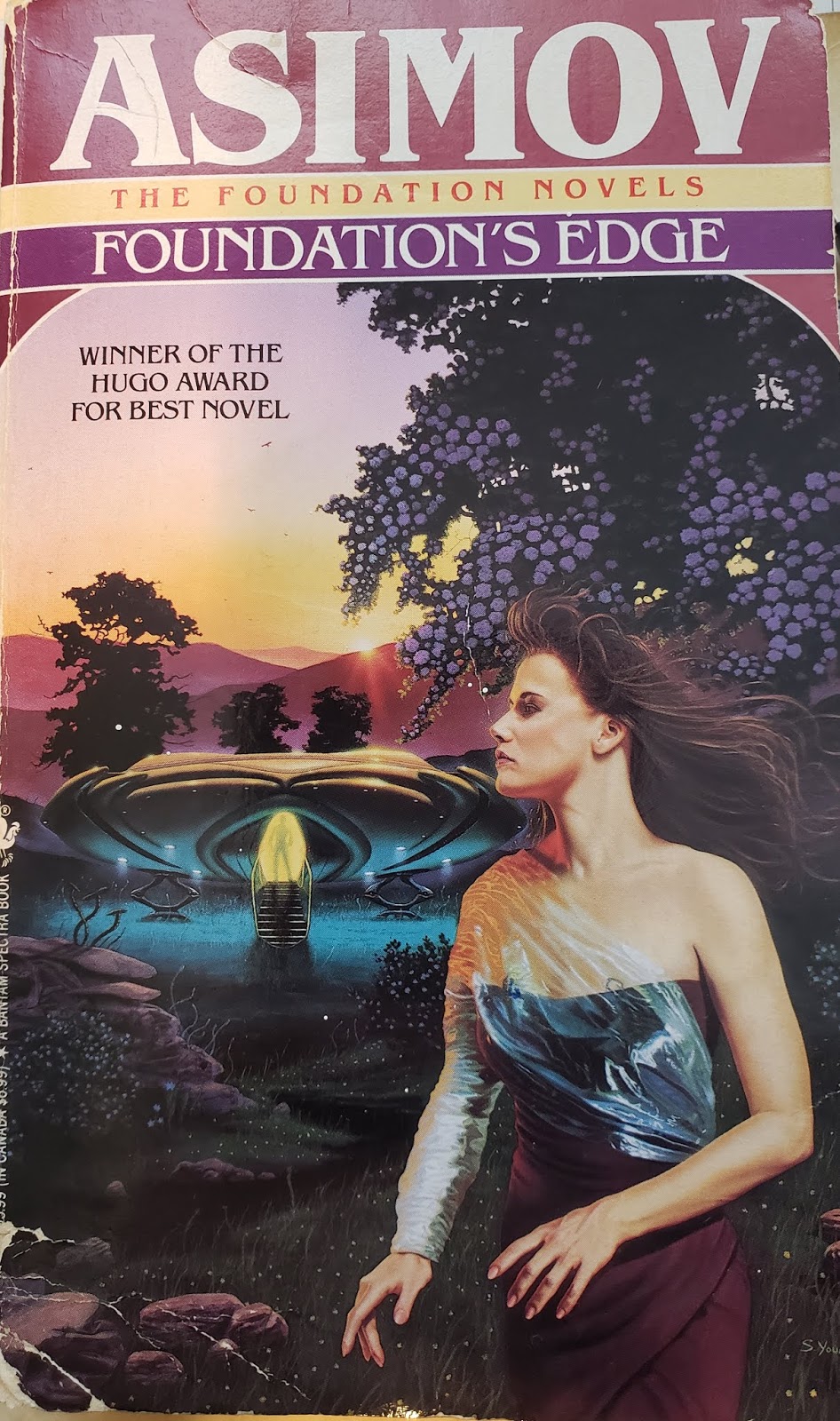
Foundation, Part 5: Foundation's Edge

Foundation’s Edge is the fourth novel in Isaac Asimov’s Foundation series.  This book is set 500 years after the events of the first book, at what should be the halfway point between Seldon’s time and the beginning of the Second Galactic Empire.  
To briefly recap the previous books in the series, the first novel introduces the science of psychohistory by which Hari Seldon predicts the downfall of the Galactic Empire and the following dark age.  Seldon plots a course of future history that will shorten the dark age from 30,000 years to just 1,000 and which will henceforth be known as the “Seldon Plan.”  Seldon establishes the Foundation to carry out his plan and help usher humanity toward the next stage of empire and, presumably, back to a preferable way of living.  
In the following novels, the Empire slides into decline as the Foundation takes on greater importance.  The Empire, of course, lashes out in its dying but is unable to fight against the superior Foundation.  Along the way, with Seldon now long dead, the Foundation and the rest of humanity learn of a Second Foundation that Seldon had built at the same time, but on the other edge of the galaxy.  
For some reason the Foundation believes that the Second Foundation is a threat to the Seldon Plan (despite the fact that Seldon built both, with the secret Second Foundation as a kind of insurance against the destruction or failure of the Foundation).  Equally unaccountably, the Foundation comes to believe that since they are built upon the principles of science, the Second Foundation must be built upon principles of emotion.  
At some point there enters a space clown nick-named The Mule who can control people’s emotions.  Some Foundationers think that he is from the Second Foundation, but he isn’t and he almost unravels the whole Seldon Plan before the real Second Foundation swoops in to save it and defeat the Mule.

Now we get into the current novel.  In Foundation’s Edge, the two Foundations are still in conflict, though the Second Foundation has gone back into secrecy and the tensions are more covert.  Asimov mirrors intrigue on both sides of the conflict.  Both Foundations feature a strong central council with an upstart member who wants to strike out to save the Seldon Plan, though they are moving in different directions, of course.  Both Foundations are tracking each other and the whole plot involves double-agents who may be triple-agents and the thing ends up being more complicated than it needs to be for where it is going.  But where it is going is actually pretty good.
I’m not going to spend too much time disentangling the whole plot here because it really is better to just read it and wade through the whole thing.  There are two narrative points that I want to hit before moving on to some other analysis.  
First is the plot line to find humanity’s origins.  In this world, Earth is not a known, inhabited planet and humanity’s origins are shrouded in prehistory.  This plot point picks up a thread from the first novel that I have written about elsewhere.  Golan Trevize, the Foundation’s young upstart is sent off on a mission to find Earth as a cover for his real mission to find the Second Foundation.  He is paired up with Janov Pelorat, a historian who specializes in Earth mythology.  This plot line goes in some unexpected directions and actually ends up serving the overarching plot in a satisfying way.  Pelorat is genuinely taken with the idea of finding Earth and ends up drumming up a lot of enthusiasm for the topic despite most people’s indifference to the question of the origin of the species.  Pelorat forces others to question why the known, inhabited planets have species that are all so similar to each other and why there is so little biodiversity on any one given planet.  He uses this line of questioning to introduce his thesis that Earth must have been a lot like what we know it to actually be like.  Asimov builds in a nice use of the scientific method to get Pelorat to make the right logical jumps.
The second plot point is the connection that Asimov makes in this novel between the world of Foundation and his robot novels.  Rather than finding Earth, Pelorat and Trevize find a planet that was first colonized by humans from Earth with the help of their robots.  Up until this point there have been no robots in The Foundation series, and this book offers an explanation.  Again, there is some satisfaction in reading through the steps to get there, so I won’t go into too much detail.  Suffice to say that Asimov puts humanity through its paces and provides some philosophical exploration of the boundary between freedom and security.  
One of the major questions that arises throughout the novel is central to the encyclopedic project in itself.  That is, what happens when future generations no longer want to participate in the projects we give them?  The whole concept of the encyclopedia is predicated upon the idea that scholars of the present will be able to communicate with scholars of the future, to provide them a basis from which to begin their own work.  It is an encapsulation of both the great hope and the massive arrogance of the whole Enlightenment.  It does not ask whether future scholars may share our same passions, or even acknowledge our own assumptions.  More than once in the novel, the question is put to the Seldon Plan.  Asimov never explicitly compare the plan to fate or raises questions of freedom of choice, but this problem parallels the questions raised around the role of robots protecting humanity and humanity’s desire to break free and live on its own.  This was perhaps the most philosophical of the Foundation novels so far because of the way that these elements come together.
This was also my favorite of the Foundation novels that I have read so far.  As far as I have been able to tell.  The original trilogy were all originally written as short stories that were stitched together into a novel-length narrative and that this is the first one to be conceived as a novel.  The difference shows.  The character development is much better and the entire narrative is more empathic because of it.  The different elements also come together much better.  In Asimov’s earlier novels, there were constant narrative threads left unresolved and interesting ideas left unexplored.  This novel shows better Asimov’s talents.  The first novels worked because of the strength of the ideas and fell apart on the weaknesses of plot and character development.  This narrative has the space to explore these threads and to bring them together.