Showing posts with label Foundation series. Show all posts

Monday, February 15, 2021

Foundation, part 8: Forward the Foundation

So here it is, I have reached the end of Asimov's Foundation series. For a minute I was going to sit down and write an outline for this post but I think I am just going to plow through the thing as is and maybe edit it later for clarity.

This novel is second chronologically in the series but it was the last one published. In the Author's notes in a couple of these novels Asimov mentions that he wrote a number of the constitutive short stories at the beginning of this career that were then wrapped up together and marketed as novels and it wasn't until the third or fourth one in the series that he actually wrote as a cohesive novel. Thinking back over the novels, that much does seem clear. In previous posts I have mentioned some of the problems of writing this way. There is another problem that this series suffers from and that is from having been written ad hoc rather than as a planned series. I will come back to this point later on, but I think that this novel shows some of the worse signs of wear due to this process. But first, the novel itself.

This novel takes up more or less where Prelude to Foundation left off. Hari Seldon is on Trantor, working on his science of psychohistory. The narrative action of that novel is more or less chronologically continuous, meaning that there are some of the expected jumps in time, but the action all takes place more-or-less in a restrained span of a few years. In this novel, the narrative keeps leaping forward in ten year increments. Seldon at 40 becomes First Minister to Emperor Cleon I and is waylaid in his study of psychohistory. At 50 he returns to his studies and benchmark events keep occurring in these 10 year increments. This, in itself is fine. It seems as though Asimov is racing to the starting point of Foundation, his original novel, to perhaps avoid having to write another book in this series. What is less fine however, is how much Hari whines as he ages. He mourns his lost youth at 40 and again at 50 and lets everyone around him know how it pains him to age. This does not come off well.

As Seldon continues through the novel his fortunes wax and wane. He is well know as an academic and for his role as First Minister, but as people learn more about psychohistory and Seldon's predictions about the decline of empire, he loses popularity and comes to be seen as a crank. There are a couple of reveals that do not seem entirely presaged by the texts and seem to be mainly narrative conveniences meant to tie up loose ends. The final 50 or so pages of the novel just seem to unwind. They are pro forma wrapping up the series and not a lot is left answered. This is a problem for the prequel because the reader already knows where all of this ends up. All of the big reveals such as the true nature of the Foundation, the existence of the Second Foundation, the appearance of the Mule and his revealed connection to Gaia all have already taken place. All that is happening is getting from the beginning to there, and all of that heavy lifting has already been done.

One of the biggest obstacles that this novel faces is something that has plagued the entire series. We are told that the science of psychohistory depends on the civilization involved being largely ignorant of its existence. The explanation goes that knowing about psychohistory or hearing predictions based on the science would alter humans' actions and would, thus, disrupt the equations and predictions involved. This is basically the time-traveler's paradox built into this science, and it is a good one, at that. But, and this is a big one, everyone seems to know who Hari Seldon is and what he does. And not just in a couple of novels, everyone seems to know about psychohistory throughout the series. This tension is never resolved. Asimov does not do anything to explain away the fact that the most well-known figure in the galaxy has a created a science that every does and does not know about. This should trash Seldon's science but it seems not to.

This novel is interesting in the sense that it does make some connections and it gives us more of Hari Seldon, a figure who is mythical throughout the series until these two prequels. This novel also sees the beginning of the Foundation. But Seldon's discoveries also suffer a bit from explanation. The science of psychohistory is more effect the less it is known. The more that Asimov tries to explain it, the thinner it seems. This is a shame because the promise of psychohistory in Foundation is so strong and is such a compelling idea. I think that most readers of science fiction understand that creating and explaining impossible technologies and sciences is pretty much impossible to pull off convincingly and most of these readers are more than willing to extend a healthy suspension of disbelief and allow authors to explain away inconsistencies in their theories. This is a bedrock of most sci-fi. We don't always need things like time travel or the like to be explained and I know that I would prefer it not be unless there is some really good way of doing it. Usually these explanations fall flat. This did a bit and it sort of deflated the entire series for me. This, again, is a shame because I think that the younger Asimov who wrote those original short stories understood this aspect of narrative. I think that younger Asimov would also not have felt the need to connect the Foundation series with his Robot series. But this is what we end up with.

There is also a problem in narrative continuity. I have not gone back to look this up, but if I recall correctly, Seldon is tried for treason at the beginning of Foundation and is exiled to Terminus where he builds Foundation. In this novel, however, the Encyclopedia Galactica entry on Seldon has him dying at his desk at the university in Trantor. There is also no Public Safety Committee or whatever it is called in Foundation to try him. These inconsistencies aren't huge and don't really change the nature of the novels but it seems odd to me that Asimov would neglect to double-check his own novel to see where this one needs to end.

But now I am done with the series. This part of the project is complete. On the whole, I really enjoyed the novels. The idea of psychohitory is brilliant and I loved the connection with the encyclopedia. These are stellar ideas and made some great reading. In the end, though, I am not certain that the series lives up to all of the hype. I found problems throughout the novels and there were some turns in the narrative that I really did not care for. I don't think I would rank this as “the greatest science fiction epic of all time” as the cover claims but it was still pretty good.


 

Monday, January 4, 2021

Foundation, Part 7: Prelude to Foundation


 Nearly a year and a half ago, I undertook to read through Asimov's classic sci-fi series, Foundation, and write about the books. This is one of several sci-fi series that I decided to read, including Frank Herbert's Dune series (which I bailed on after 4 books), Arthur C. Clarke's Rama series (which I also bailed on after 2 books), and James SA Corey's The Expanse series (of which I am currently reading the sixth book and will likely continue). One of the major differences that I see in these series are those that were planned to be series of novels (or even novels to begin with) and those that were not. Corey's series was planned to be a long-running series from the start, and the novels show it. Each novel is more or less complete on its own, but they also build to a broader arc across the novels. The novels serve more as episodes than as simple stand-alones, meaning that you could read just one of the novels without the others, but it would make more sense to read them together.

These other series, though (I am necessarily leaving out a lot of other series and authors I could include, but this is the choice I am making), seem to be caught by surprise by their own sequels. That is, the sequels must pick up after a conclusion has been reached in the predecing book, and not always convincingly. Both Herbert and Asimov get around this problem by jumping hundreds or thousands of years into the future. This way, there is no messy character continuity to keep up and any narrative gaps can be explained by the chronological gap. The exception to this is that Herbert keeps bringing Duncan Idaho back from the dead for some reason.

When I catch myself wondering if I am being overly harsh in judging these authors for returning to worlds that may be personal or fan favorites, and may well have proven lucrative as well, I just keep remembering all of the series I have quit reading for one reason or another. I also think about the nose-dives that some of these series take. Redezvous with Rama, for example, may be one of my favorite golden era sf books, but Rama II was enough to stop me in my tracks. Likewise, The Forever War by Joe Haldeman is a personal favorite while Forever Peace is merely okay and I haven't yet tried to get into Forever Free. I also think about the series I have loved. Kim Stanley Robinson's Mars trilogy and the book of short fiction that followed remains among my favorite novels. The same is true for Cixin Liu's Remembrance of Earth's Past series. So it isn't the form of the sequel itself that is bad. There are a lot of writers who can beautifully pull off continuing novels in a fictional world.

To bring this back to my original topic, Asimov must have felt a bit like Arthur Conan Doyle resurrecting Sherlock Holmes after killing him off in returning the galaxy of Foundation. After all, he had written the series to an end in Foundation and Earth that was, if not completely satisfying, at least conclusive. Prelude to Foundation takes up Hari Seldon's rise to prominence on Trantor and his early adventures. Some of it is good and, as a stand-alone novel, it has its charms. However when taken in the context of the rest of the series, it leaves a little wanting.

Prelude to Foundation takes place first chronologically in the Foundation series, but it was written second-to-last. At the beginning of the novel, Seldon has traveled to Trantor and delivered a paper on psychohistory. This immediately catches the attention of Cleon I, emperor of the Galactic Empire. Seldon presentation proved the science of psychohistory as theoretically possible but Cleon thought that this meant that Seldon could predict the future and brings Seldon to him in order to gain his services. Hari resists, explaining that there is no practical application for the science and that it might take his entire lifetime to actually apply it.

Disappointed Cleon lets him go but instructs his right-hand to keep tabs on Seldon so that they can take him back when they can use him. Seldon is rescued from his surveillance by a friendly stranger who then helps to keep him in hiding for most of the rest of the novel.

Seldon ends up traveling to varied parts of Trantor to stay ahead of imperial reach and there is a lot of local flavor type interactions that haven't aged well. Seldon creeps on women and he meets a kid whose speech wouldn't be out of place in a Horatio Alger novel. In the end (no worries, I won't spoil it), Seldon already knows where things will end up in Foundation and Earth, even though this takes place several thousand years after his death.

This is the problem of prequels. There is no real tension in the danger that Seldon faces because I have already read five novels in which he plays a major role and know that he doesn't die yet. Granted, he dies in the opening pages of Foundation, but by then his mark is made and his influence extends millennia. Next, Asimov retcons “foreshadowing” of events that take place far in the narrative future, but which the reader has already experienced if they are reading in publication order. This generally doesn't read well and it seems more like an aging rock group begrudgingly playing the hit they wrote 30 years prior than an authentic narrative embellishment. There are then also the connections that Asimov wants to make between Foundation and his Robot series. This connection seemed unnecessary in Foundation and Earth and it leads to more phony foreshadowing in this novel, too. I haven't read enough of the Robot series to know how this affects that series, but perhaps I will head to those books after this series is done to find out for myself.

Also, and most damningly, Asimov tries to be funny in this book. For all that I admire in Asimov's writing, it is never for his wit. See, on Trantor there is a rival faction to the Emperor and that is Wye sector. More than once, a character will mention the name “Wye” and the interlocutor will proceed to give an unneeded and unasked-for explanation, thinking the first character was asking, “Why?” They are homonyms, get it!

I've shit on this book enough. There are things that I liked about it. Hari Seldon has been a force in this whole series but he has been distant. As I mentioned, he dies very early in the series and he just keeps showing up as a pre-recorded hologram. But here, he is an actual character, and he is one of Asimov's more dynamic and round ones. Beyond this, he is a moral character who wants to both do the right thing and stand by his science. The narrative itself is cohesive and shows Asimov's inventiveness in creating these different sectors with different traditions and styles. There are a couple of genuine surprises that kept the novel interesting and it ended up being an enjoyable read.

I won't say that this is my favorite in the series, but it was serviceable. I have one more book to go before I can put this series to bed and I'm not sure what to expect from it. I suspect that it will be a grab bag, a little like this novel is. I know that it follows Hari's story between the end of this novel and the beginning of Foundation, but I don't know what time period it covers. I am hoping that there will be a bit more explanation of psychohistory and I am really hoping that it doesn't go in a direction that undoes what made Foundation great.

Monday, June 1, 2020

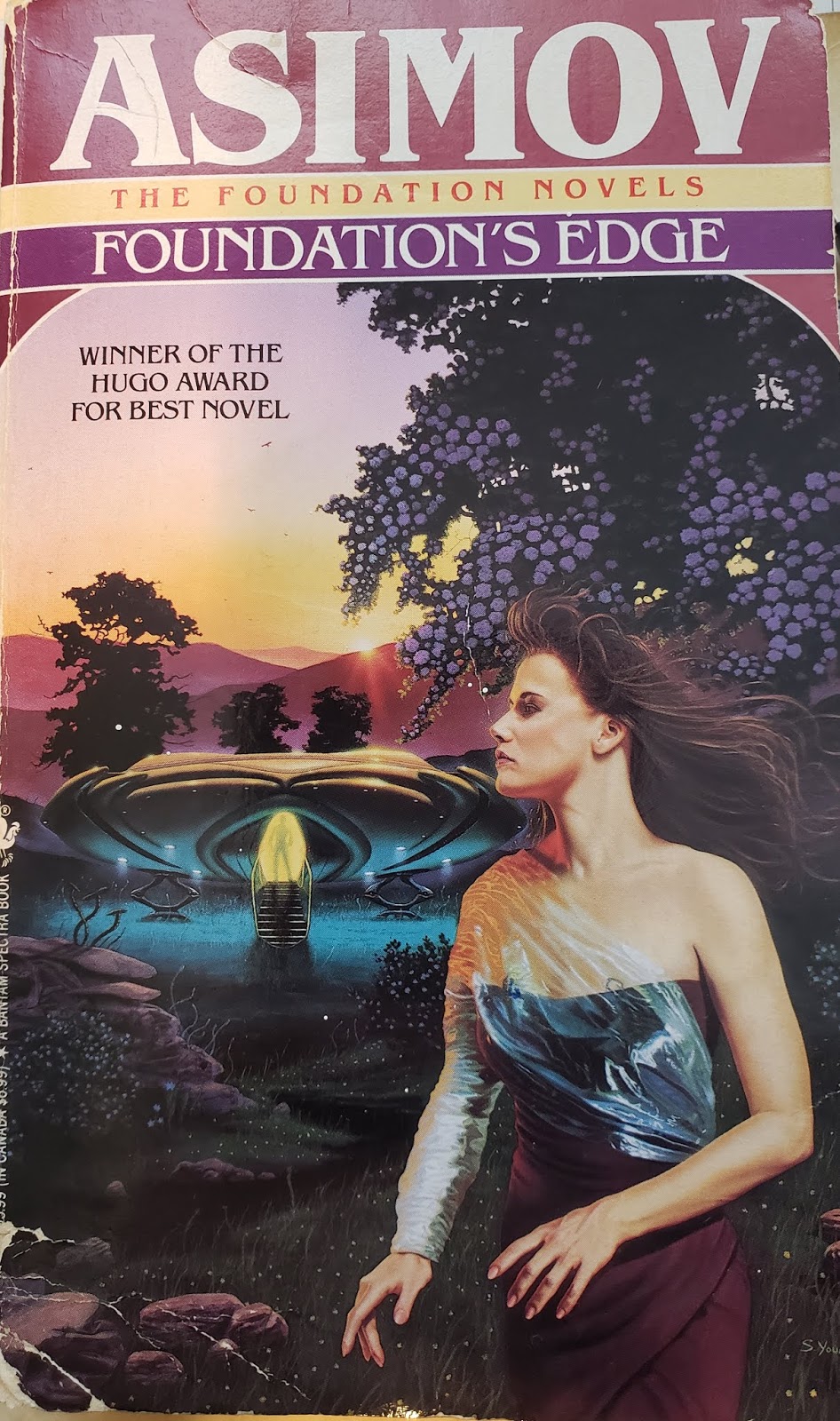
Foundation, Part 5: Foundation's Edge

Foundation’s Edge is the fourth novel in Isaac Asimov’s Foundation series.  This book is set 500 years after the events of the first book, at what should be the halfway point between Seldon’s time and the beginning of the Second Galactic Empire.  
To briefly recap the previous books in the series, the first novel introduces the science of psychohistory by which Hari Seldon predicts the downfall of the Galactic Empire and the following dark age.  Seldon plots a course of future history that will shorten the dark age from 30,000 years to just 1,000 and which will henceforth be known as the “Seldon Plan.”  Seldon establishes the Foundation to carry out his plan and help usher humanity toward the next stage of empire and, presumably, back to a preferable way of living.  
In the following novels, the Empire slides into decline as the Foundation takes on greater importance.  The Empire, of course, lashes out in its dying but is unable to fight against the superior Foundation.  Along the way, with Seldon now long dead, the Foundation and the rest of humanity learn of a Second Foundation that Seldon had built at the same time, but on the other edge of the galaxy.  
For some reason the Foundation believes that the Second Foundation is a threat to the Seldon Plan (despite the fact that Seldon built both, with the secret Second Foundation as a kind of insurance against the destruction or failure of the Foundation).  Equally unaccountably, the Foundation comes to believe that since they are built upon the principles of science, the Second Foundation must be built upon principles of emotion.  
At some point there enters a space clown nick-named The Mule who can control people’s emotions.  Some Foundationers think that he is from the Second Foundation, but he isn’t and he almost unravels the whole Seldon Plan before the real Second Foundation swoops in to save it and defeat the Mule.

Now we get into the current novel.  In Foundation’s Edge, the two Foundations are still in conflict, though the Second Foundation has gone back into secrecy and the tensions are more covert.  Asimov mirrors intrigue on both sides of the conflict.  Both Foundations feature a strong central council with an upstart member who wants to strike out to save the Seldon Plan, though they are moving in different directions, of course.  Both Foundations are tracking each other and the whole plot involves double-agents who may be triple-agents and the thing ends up being more complicated than it needs to be for where it is going.  But where it is going is actually pretty good.
I’m not going to spend too much time disentangling the whole plot here because it really is better to just read it and wade through the whole thing.  There are two narrative points that I want to hit before moving on to some other analysis.  
First is the plot line to find humanity’s origins.  In this world, Earth is not a known, inhabited planet and humanity’s origins are shrouded in prehistory.  This plot point picks up a thread from the first novel that I have written about elsewhere.  Golan Trevize, the Foundation’s young upstart is sent off on a mission to find Earth as a cover for his real mission to find the Second Foundation.  He is paired up with Janov Pelorat, a historian who specializes in Earth mythology.  This plot line goes in some unexpected directions and actually ends up serving the overarching plot in a satisfying way.  Pelorat is genuinely taken with the idea of finding Earth and ends up drumming up a lot of enthusiasm for the topic despite most people’s indifference to the question of the origin of the species.  Pelorat forces others to question why the known, inhabited planets have species that are all so similar to each other and why there is so little biodiversity on any one given planet.  He uses this line of questioning to introduce his thesis that Earth must have been a lot like what we know it to actually be like.  Asimov builds in a nice use of the scientific method to get Pelorat to make the right logical jumps.
The second plot point is the connection that Asimov makes in this novel between the world of Foundation and his robot novels.  Rather than finding Earth, Pelorat and Trevize find a planet that was first colonized by humans from Earth with the help of their robots.  Up until this point there have been no robots in The Foundation series, and this book offers an explanation.  Again, there is some satisfaction in reading through the steps to get there, so I won’t go into too much detail.  Suffice to say that Asimov puts humanity through its paces and provides some philosophical exploration of the boundary between freedom and security.  
One of the major questions that arises throughout the novel is central to the encyclopedic project in itself.  That is, what happens when future generations no longer want to participate in the projects we give them?  The whole concept of the encyclopedia is predicated upon the idea that scholars of the present will be able to communicate with scholars of the future, to provide them a basis from which to begin their own work.  It is an encapsulation of both the great hope and the massive arrogance of the whole Enlightenment.  It does not ask whether future scholars may share our same passions, or even acknowledge our own assumptions.  More than once in the novel, the question is put to the Seldon Plan.  Asimov never explicitly compare the plan to fate or raises questions of freedom of choice, but this problem parallels the questions raised around the role of robots protecting humanity and humanity’s desire to break free and live on its own.  This was perhaps the most philosophical of the Foundation novels so far because of the way that these elements come together.
This was also my favorite of the Foundation novels that I have read so far.  As far as I have been able to tell.  The original trilogy were all originally written as short stories that were stitched together into a novel-length narrative and that this is the first one to be conceived as a novel.  The difference shows.  The character development is much better and the entire narrative is more empathic because of it.  The different elements also come together much better.  In Asimov’s earlier novels, there were constant narrative threads left unresolved and interesting ideas left unexplored.  This novel shows better Asimov’s talents.  The first novels worked because of the strength of the ideas and fell apart on the weaknesses of plot and character development.  This narrative has the space to explore these threads and to bring them together.  

Monday, March 9, 2020

Foundation, Part 4: Second Foundation

This is part four of an ongoing series about Isaac Asimov's classic Foundation series.  I cover the first two books with varying degrees of detail here and here, provide a bit of an intro to this blog series here, and have an essay that I am quite proud of posted on tor.com here.
I don't want to retread too much ground here that I have already covered.  But I will warn that the tor.com piece is about Enlightenment philosophy and encyclopedias, and it is likely that I am going to return to these topics.

The first couple of novels plot out the downfall of the vast Galactic Empire as predicted by Hari Seldon and the science of psychohistory.  Seldon sets up an institution called the Foundation that is meant to serve as a chronicler of the collected knowledge of mankind, but covertly works as a bulwark against the Empire's fall.  This is all meant to shorten a dark age in the power vacuum that would have lasted for 30,000 years, but can be gotten over with in 1,000, thanks to Seldon's psychohistory.  This is a lot to get through, but the broad strokes don't matter too much right now.
Second Foundation opens with the Mule, the villain from Foundation and Empire, seeking out a legendary Second Foundation that is believed to exist as a plan B to the Foundation.  There is some notion that Seldon built the Second Foundation on the opposite side of the galaxy as Foundation in order to safeguard it.  This novel covers the fall of the Mule.  This character initially comes to power because he is a mutant who can control the emotions of others.  This helps him to force and keep loyalty in anyone he meets and, it is intimated, he is able to use emotion to counter and win out against science.  The Second Foundation beats the Mule and the original Foundation comes back to power.  There is a bit of a confusing power struggle wherein the Second Foundation remains hidden and the Foundation begins to suspect that the Second Foundation, also built around emotion, is trying to overtake it.  Again, these are just broad strokes intended to get to some more interesting parts.

I was first interested in the idea of the tension between emotion and science, or reason.  It seems an odd tension for Asimov to build into this series because these are not really counters at all, but complements.  What is it about emotional control that should be a threat to science in the first place?  There is also nothing necessary in the Second Foundation being any different from the first Foundation.  They could, and it seems logical that they would, be built upon the same principles.

I also found it interesting that Asimov plays more with the mythical rendering of Seldon's Plan.  In the earlier books, the characters had readier access to Seldon's ideas and plans but, by this point hundreds of years later, they have begun to regard the Plan itself as an agent.  This abstraction from the Plan actually works with the science of psychohistory as defined by Asimov because the knowledge of psychohistory disrupts its working.

One of the best parts of the series so far is the way that the whole science of psychohistory plays with the "great man" theory of history, both confirming and challenging it.
On one hand, Seldon continues to influence.  People still puzzle over his plan and the second foundation.  They also worry that the Mule was not predicted and unpredictable, so ruined the plan.
On the other hand, psychohistory is concerned with masses, billions of people.  Individual efforts don't matter.  Only mass, civilization-scale, activities have influence.  Except for Seldon, of course.

Monday, November 25, 2019

Foundation, Part 3: Foundation and Empire

Foundation and Empire, the second novel in the Foundation series picks up more or less where the first novel leaves off.  This book follows much of the same plan that the first one does and, like any good sequel, it expands on the themes of the original.
Asimov picks up on the long arc of history that he set in motion in the first novel.  That is, the Foundation continues to consolidate influence as the sole remaining scientific powerhouse as the Galactic Empire continues its fall.  Now at a greater remove from the events in the first novel, Seldon, Psychohistory, the encyclopedists, and even the Foundation itself have taken on mythic tones.  As the empire falls apart, lines of communication and trade likewise deteriorate.  This isolates planets on the periphery of the galaxy that then revert to feudalism.  Where another author might summarize much of the above, Asimov creates separate scenes, interspersed through time and space to demonstrate these plot lines.  In a way, this helps to develop the drama of history, but it also undercuts it by revealing the artifice of the narrative.  The events that Asimov writes about are so far distant in time and space that they have to be -- essentially -- sped up.  Each of the narrative slices provides a peek into one time and place before shuttling off to the next.  This creates an exaggerated urgency because he can collapse events that might take place fifty or one hundred years apart to make them seem more causal, more immediate.  Whatever the actual events of history, Seldon's immediate influence has shifted.  While in the first novel, Seldon's holographic appearances were eagerly anticipated, Asimov reveals that two of the subsequent appearances had no audience.  In this sense, Seldon and psychohistory have become more totemic.
Then, two weird things happen.  First, people start talking about someone called the Mule.  There are all kinds of rumors about the Mule and about the powers that he has.  The other thing is that two of the characters meet a space clown named Magnifico.  If you are a reader like me, you will have noticed that Asimov goes to great pains not to describe the Mule and you will further suspect that this space clown actually is the Mule.  This turns out to be the case.  Also, the space clown Mule/Magnifico can essentially read people's thoughts and alter their emotions.
There are some cool scenes of the empire in decline.  As technology declines, colonists are forced to turn back to the soil and bartering.  The Mule wants to rebuild the empire but is frustrated in the end because he is unable to locate the mythical second Foundation that is located somewhere on the opposite side of the galaxy form the original Foundation.  The two separate Foundations are set up in the first novel but the second one has been kept more hidden.  Some of the characters speculate that the scientific first Foundation is countered by an emotional second Foundation which would be ideally suited to fighting against the Mule.
I lost track of where Seldon is in all of this.  Honestly, the space clown threw me a bit and the Mule seemed like a pretty dumb character so I glossed over parts of this book.
As sequels go, this isn't bad.  The book does play around with some of the same themes that made Foundation interesting and it extends other ideas.  However, this book also loses even more focus on the encyclopedia which is the thing that drew me to these books in the first place.

Monday, November 11, 2019

Foundation, Part 2: Re-reading Foundation

I meant to sit down and write this post after I finished reading the novel about a week and a half ago but I got caught up in some other writing projects and this fell to the wayside.  What this means is that I meant to give a more in-depth summary and analysis of Asimov's classic Foundation but what you are going to get is more nebulous.  I still have some notes from what I was going to write before, so I am going to work from that.
This may get sloppy and I know that I am going to miss some of the details.  I am okay with that.
This was my third reading of this novel.  The first time I read Foundation was in graduate school when I was working on the encyclopedic novel.  This novel is not encyclopedic, but it does contain thematic elements of the encyclopedia.  This is something that drops out of other novels (as I have written elsewhere) but is pretty heavy in the first one.
The second time I read this novel was with my sci-fi reading group.  We would alternate between reading classic sci-fi and newer novels.  Foundation filled the bill for a classic sci-fi novel that many in the group wanted to read, so we took it up.  I don't remember much about that conversation now, but I probably spent some time talking about the Encyclopedia Galactica.
This third time I am taking it up is with a view toward reading the entire series.
Foundation opens with a couple of really fascinating premises: the science of psychohistory and the aforementioned Encyclopedia Galactica.  I have written about the encyclopedia elsewhere, so I want to focus on psychohistory here.  This science blends sociology, group psychology, and statistical analysis into a science that may be used to predict future events.  The idea is that a properly trained psychohistorian can take a set of data about a current culture and its broad trends and use this to judge the likely outcome of certain events.  Hari Seldon is the most gifted practitioner of psychohistory and he uses it to predict long-scale historical events, including the eventual downfall of the current galactic empire, the dark ages that will follow the fall, and the eventual rise of the second empire.

The science of psychohistory is interesting because it seeks to quantify human action on a macro-scale.  Asimov explains away individual action by relying on probability and using civilization-wide sample sizes to make predictions.  This means the psychohistory relies on the broadest of trends, making individual contributions much too small to be a factor.
In order to show actions on this broad scale, the narrative must make leaps into the future.  This is not an uncommon device in sci-fi, but it takes special care to pull it off.  The author must keep certain thematics steady enough draw along plot and must be careful to re-establish context after each jump forward in time.  Each jump requires new characters as well.  This means that there are a lot of balls to keep in the air at once to pull it off.
Asimov does this with varying success.  The idea of psychohistory and following the plotting of civilization is compelling enough to draw readers along, even as they may have difficulty keeping characters and events straight.  Hari himself remains a constant throughout the narrative despite dying early on in the timeline.  He does this by preparing holograms of himself that are designed to appear at specific times in the future to help guide civilization along its proper course.  Seldon realizes that he must simultaneously nudge civilization in the right direction while also keeping it ignorant of his plan.  This is an unresolved problem of the whole scheme because people begin anticipating these emergences of new information, these "nudges" from Seldon.  Asimov never gets deep enough into the mechanics of psychohistory to deal with this kind of anticipation.  There must be a profound faith in Seldon's prescience for this to be carried off at all.  And this seems to be at odds with the tenets of psychohistory itself.

Ultimately, this is a really enjoyable book.  It is compelling and there is a lot going on.  Asimov is always a big idea author and I am generally ready to forgive the small details that don't always add up.  I tend to think that his characters are generally weak, but again, his are novels of ideas and not character studies so it is easy to set this to the side and enjoy the novel as thought-experiment.

Thursday, August 15, 2019

Foundation, Part 1: An Introduction

I first read Isaac Asimov's classic novel Foundation while in graduate school working on my doctoral dissertation.  I was interested in the way that Asimov uses the encyclopedia as a focal point at the beginning of the novel.  As I have noted elsewhere, this is a point that drops out of the series fairly quickly.  At the time, I read the first couple of novels  before posting interest.  Later on, I read Foundation with my sci-fi group.  I don't remember the conversation about this one but I probably brought up encyclopedism and the Enlightenment a bunch.
Just recently, I decided to take a run at the whole series.  I have accumulated all of the books over the last few months and this is my attempt to read all of them and to write about them here.  I don't expect to enjoy all of the books, but I do hope to find the good in them.  Asimov is a writer who I think is great with ideas and plotting but terrible with character.
I don't have any particular aim in reading these books this time, so we'll see how this goes.
Be on the lookout for subsequent installments in this series.