Showing posts with label Kim Stanley Robinson. Show all posts

Monday, May 24, 2021

Imagining Earth's Future

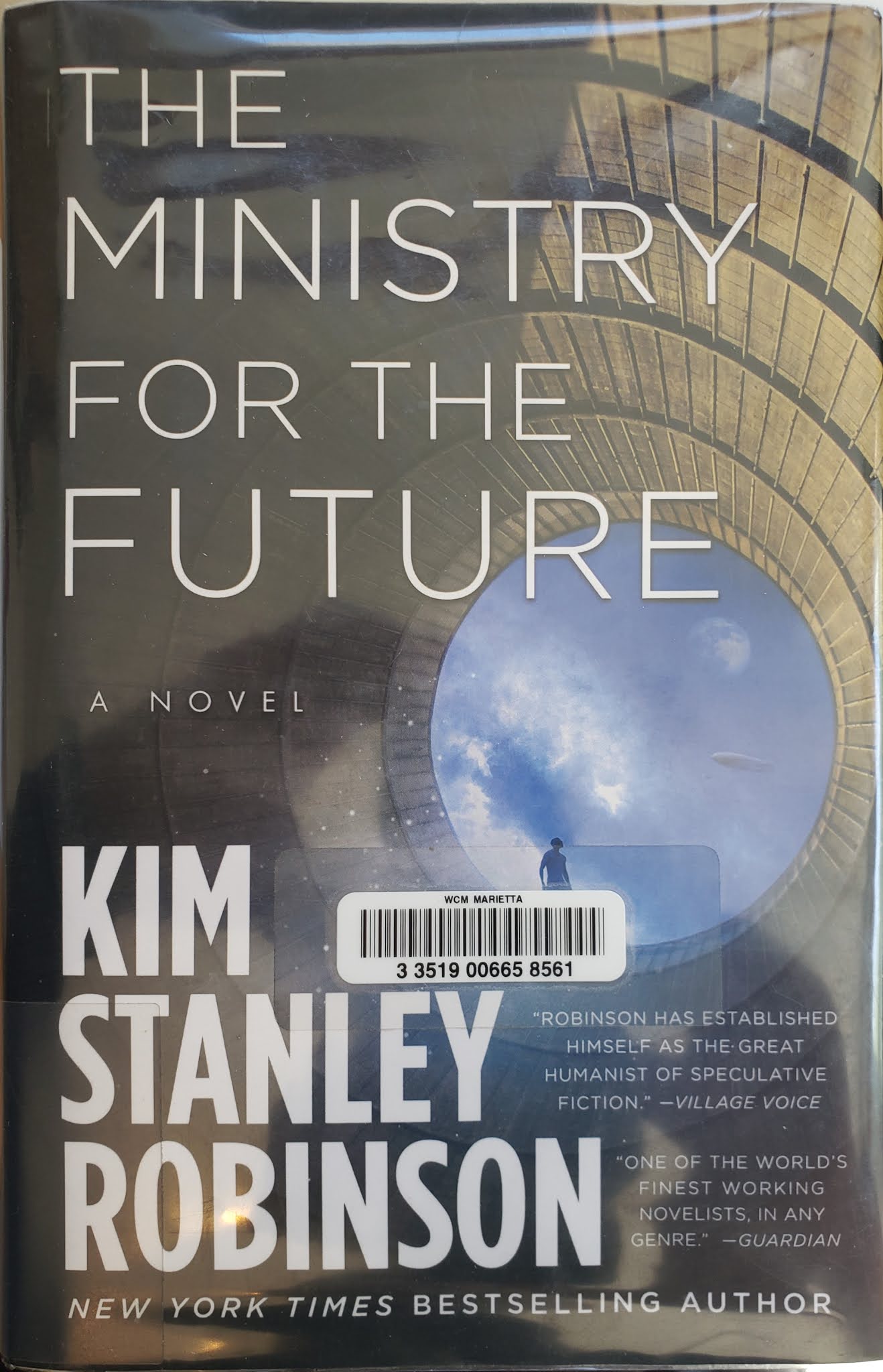
Kim Stanley Robinson seems to write two kinds of books. Both are hard sci-fi in the sense that they focus on either current technology or near-future technology extrapolated from current science. Both kinds of books are quick to locate the political elements of technology and science. While one sort of novel follows in the vein of his Mars trilogy – set in space and looking toward a sort of hopeful exploration (though often fraught with its own political difficulties) – the other kind of novel brings his readers back to Earth to take a hard look at the problems that we face here. The Ministry of the Future is one of the latter kind. While the title makes this sound like a time travel narrative, it is actually about a UN ministry that is established as a proxy for future generations as a way to keep current political entities from taking advantage of as-yet-unborn people. This in itself is an interesting idea because of the broad rhetoric used across the political spectrum in America about the importance of children, fetus, the future, and so on. In this novel, Robinson points out the fact that our systems loves to short the future while also counting on those yet to come to solve the ridiculous problems that we both create and shirk responsibility for.

This novel is a careful bricolage of narrative, ideas for problem solving, international intrigue, meditations on environmentalism and capitalism, and speculation on future technologies and bioengineering. The central narrative of the novel, detailing Mary Murphy's heading of the Ministry for the Future and the attempts she and her team make to bring the Earth back from the brink of destruction, makes up a small portion of the book. Robinson relies heavily on juxtaposition throughout to patch together scenes of striking contrast to highlight the manifold difficulties that we face. This is a necessary tactic because Robinson recognizes that the problems that we face are intricately interconnected.

For as bleak as much of the novel can be, Robinson does find a way to save the world. It takes invention of a new crypto-currency backed by the major economies of the world and based on carbon sequestration and the implementation of many other global-scale projects. But we have to make it through mass carnage and near collapse to get there. The disheartening revelation of the novel is that the wealthy and developed nations must experience the world as others do in order to take action.

I do not find this kind of Robinson's novels as entertaining to read as his space exploration novels, but they are still important to read. Robinson wants to think about a future that is based in the present day and fully cognizant of the problems that we face. He never imagines a future in which humankind is magically no longer like humankind. This can be disheartening, but it is a more useful way of looking at the future.


Monday, December 7, 2020

Book Notes, pt. 4

 Sometimes I don't feel like writing up full posts on books. Sometimes I want to write short notes about things that aren't books. Here are a few things I came across recently:


Physics of the Future by Michio Kaku

So recently I decided I wanted to try reading more pop science books to bolster my sf reading. I have to stick to pop science because my education in any practical science is decades old at this point and I don't know how to read actual science writing. I may wade into reading science journalism if I get the chance. I happened across two books by Michio Kaku in the local used book store near the house where I used to live and thought that these may be a good intro.


This book is basically a prediction of what the next 100ish years might look like. I kinda liked it for what it is except for three things. Kaku keeps using the phrase “the push of a button” throughout the book to show how easy it will be to do or obtain things. It just struck me that this is an odd turn of phrase for a futurist to use because it seems almost archaic already. There may be a more apt metaphor to use.

The second thing should not be so surprising. It is his fixation on science as a means of solving all of the worlds current and upcoming problems. He does point to some serious problems that we will face, but it seems to me that many of them will have social or political solutions rather than scientific ones. He also tends to make broad historical generalizations (he frequently praises innovations of antiquity that originate in the West but not the East. He also credits Newton as the inventor of calculus without mentioning Leibniz), and makes mistakes of periodization.

Finally, he treats all scientific progress as though it is inevitable and irreversible. In fact, he specifically writes that there is no way to stop this progress. This mainly wasn't a problem in the book as he wrote about potential advances and their implications. However, he would editorialize from time to time and it seemed to reduce the importance of nearly everything except technological advancement and it placed us, now, at an historical cusp. It put this generation at the center point of human advancement and history. This seems misguidedly optimistic.

I liked the book in general and found some interesting ideas in it. His speculations on the near, and even mid-range future (the next 50-70 years-ish) seem accurate and introduced me to a lot of existing tech that I did not know about. The author evinces great credibility in scientific areas. I'll reserve further judgment until I read the other book of his that I bought.


Science Magazine podcast

After listening to the great podcast Our Opinions are Correct, I decided to check out the Science Magazine podcast that one of the hosts, Annalee Newitz, recommended. I really like it. The episode that I listened to was about researching Coronavirus vaccines and what might happen in the competition between these different groups of scientists to develop one.

The show is geared toward a general audience and brings in experts in the field. The reporting is done by science writers who are good at moderating the information and presenting it in an informative way. Some of the content is follow up from the magazine such as interviews with authors or other experts covered subject, and other content seems independently driven. It is pretty good.


Red Moon by Kim Stanley Robinson

KSR is one of my favorite contemporary authors. His writing is crisp, science is hard, and he always includes the political angles that are left out by so many other authors. This is a great aspect of his writing that I want to come back to later. (I intend to write a series on his Mars trilogy, maybe next year.) This book sorta fell to the background of my reading this month. I enjoyed it and made my way through it but didn't focus on it as much as I would have other work.

I had originally hoped that this book would exist in the Mars timeline based on the title, but it does not. The novel imagines a near-future when the Moon is colonized and a lot of the international tensions that currently exist on Earth are expanded/exported to the Moon. It is a cool idea and, as always, the tech is really great. Recommended read.


Monday, April 6, 2020

The War of Two Worlds

The second novel in this Poul Anderson book, The War of Two Worlds, plays much like the first one, Planet of No Return.  Space travel is normal and the major conflicts arise between humans and aliens.
The War of Two Worlds is, as the title would suggest, something of a take on H.G. Wells' classic novel War of the Worlds, but the conflict between humans and Martians is twisted a bit.  In Anderson's novel the conflict between Earth and Mars is sparked by a false flag operation by shape-shifting aliens from Sirius.  The aliens, exiled from their own planet, pit Earth and Mars against one another so that they can swoop in and mop up both weakened parties.  The novel is good pulp and imaginative for what it is.  It even seems to forecast some elements that The Expanse picks up regarding these different, alien political factions.

This book got me thinking about a different topic altogether, however, that is now a staple in science fiction: the identity of Martians.
From novels like Anderson's and Wells' to Bradbury's Martian Chronicles, and more, Martians have always been an alien species that are generally humanoid and have identifiable, if not down right sympathetic, motives.  Martians want a home or conquest, or have some other need that must be met. 

More and more, however, the Martians are us.  Martians are humans.  Going back to Kim Stanley Robinson's 1992 Red Mars, those who inhabit the red planet are not aliens from a separate evolutionary line, they are humans who have either traveled there or were born there.  Beyond Ronbinson's Mars trilogy, this holds true for Andy Weir's The Martian, the humans from various regions in The Expanse, and I'm sure dozens of other examples.
Robinson and James S.A. Corey create humans with different body shapes to show their origins but they are all humans.  This move is significant, I think, because it reflects a different ethos regarding our place in the universe.  The actual aliens, the ones who truly come from beyond, are not recognizable by their motivations or body shape, they are truly alien. 
In The Expanse, the aliens represented by the protomolecule have their own powers and motivations that are beyond the characters' ability to understand.  I have drawn the parallel between The Expanse and Cixin Liu's Remembrance of Earth's Past before, and I think that it holds here as well.  The aliens in Liu's trilogy are equally foreign and are nearly abstract in their differences from humans.
This tendency shows both the unity and the divisions within humanity. 

Monday, January 13, 2020

The Expanse, pt. 1: Leviathan Wakes

James S.A. Corey's Leviathan Wakes is a big book that is a part of a big series.  The scope of the novel is equally big.  There is a lot about this author (a pseudonym for two authors working together) and the series (that is currently being adapted into the series The Expanse by Amazon) that merit attention, but I am just interested in this novel so far.
It must have been a few years ago when I started dedicating a lot more time to reading and writing about sci-fi that I started seeing these books.  Initially, I thought that this was an old series because there were so many of them.  Each of the book covers features similar cover art and the same lettering style.  It looks a lot like a reissue of a recovered series.
But this novel, the first in the series was just published in 2011 and the books have been coming out nearly every year with the total up to 8 and a new novella just announced.  So, I had missed the boat a bit until now.
The book opens with a prologue that narrates a terrifying scene of a woman trapped in a storage locker aboard the spaceship Scopuli after it had been forcibly boarded by a hostile raiding party.  Julie, the woman trapped in the locker, will become the center of a shaggy-dog detective narrative around which the sci-fi narrative is wrapped.
The novel's two main characters, Holden and Miller (a disgraced naval officer and disgraced police detective, respectively), carry two separate narrative strands that eventually merge as the case of the missing girl evolves from a wandering daughter case to massive, interplanetary political upheaval.
The exact details of the plot dissolve into the background as the story unfolds.  There is an ancient alien virus, tribal conflict between humans of different colonial origins, and futuristic hardware.  The world built in the novel is one that is familiar to fans of contemporary sci-fi.  That is, a world that is similar to our own in its lived-in qualities.  This is not the glossy world of Star Trek where everything is military-grade and state of the art.  The ships and gear range from the bleeding edge of technology to patched-together, aging industrial haulers.
There is a lot going on in this novel, too much to cover here, but I will say that this was an enjoyable read.  Corey's matter-of-fact description of inter-faction conflict is reminiscent of Heinlein's The Moon is a Harsh Mistress.  In the world of this novel, colonialism travels into space along with humanity as people living in space stations in the and outside of the asteroid belt, on Mars, the Moon, and back on Earth compete for resources and jockey for political power.  The descriptions of the bodies of human that are born and live in different gravities echoes the work of Kim Stanley Robinson, who so frequently muses on the effects that deep space will have on human evolution.
When my recently pared-down sci-fi book group decided to read this novel, I went and bought a box set of the first three novels.  I look forward to continuing this series and seeing what the authors can do with the world they have created.  I am a little torn about whether I want to begin watching the series just yet.  I may hold out until I get further into the books.

Friday, February 22, 2019

Sci-fi's Unsatisfying Sequel Problem

Recently I finished reading the sequel to Arthur C. Clarke's groundbreaking Rendezvous with Rama.  This second book in the Rama series, Rama II, details a second excursion to meet a second mysterious alien ship.  The book itself is rather uninteresting.  It follows up on many of the themes of the original novel, but fails to captivate in the same way.  Rendezvous with Rama focuses on the unknown ship's construction as the cosmonauts attempt to divine its origins and purpose.  This all established, Rama II introduces a new set of cosmonauts and delves into their interactions instead.  We do get more descriptions of the interior of the Raman ship, but they are largely just developed detail of the first novel rather than any extrapolation into new material.  There are a few revelations, but these are never built upon.  For example, one of the cosmonauts (in an unresolved treachery plot) runs across doppelgängers of the first crew to visit the first ship.  This should be a major turning point of the novel because it reveals that the first interstellar ship is in contact with the second, despite there being no evidence of any sentient alien crew, and also that the "biots," or robotic alien animals that both human crews encounter may actually be replications of species that the ship had previously been in contact with.  The discovery goes largely uncommented upon.
The problem with Rama II is one that pervades a certain era of sci-fi.  Clarke's other noted series, 2001 and its sequels suffered the same fate as well as Asimov's Foundation series, among others.  These series all began as brilliant one-off novels that foundered and lost their way.  Rama II was unnecessary and I cannot imagine that the remaining sequels get any better.  In fairness, Rama II has the potential to be a good stand-alone.  The character development is good and there is the making of a good thriller plot within the novel.  However, as a sequel to Rendezvous with Rama, it breaks too sharply from the thematics that made the original striking.
I read the first novel long after I had begun reading hard sci-fi such as that written by Kim Stanley Robinson, but is easy to see the influence that Rendezvous had on Robinson's work.  That novel is deeply invested in the logistics of interstellar travel and the difficulties humans would face when trying to interact with a true alien culture/technology.  There is some character drama in the book, but it is largely in service to this main theme.  Rama II loses that focus.