Showing posts with label Sci-fi. Show all posts

Monday, May 24, 2021

Imagining Earth's Future

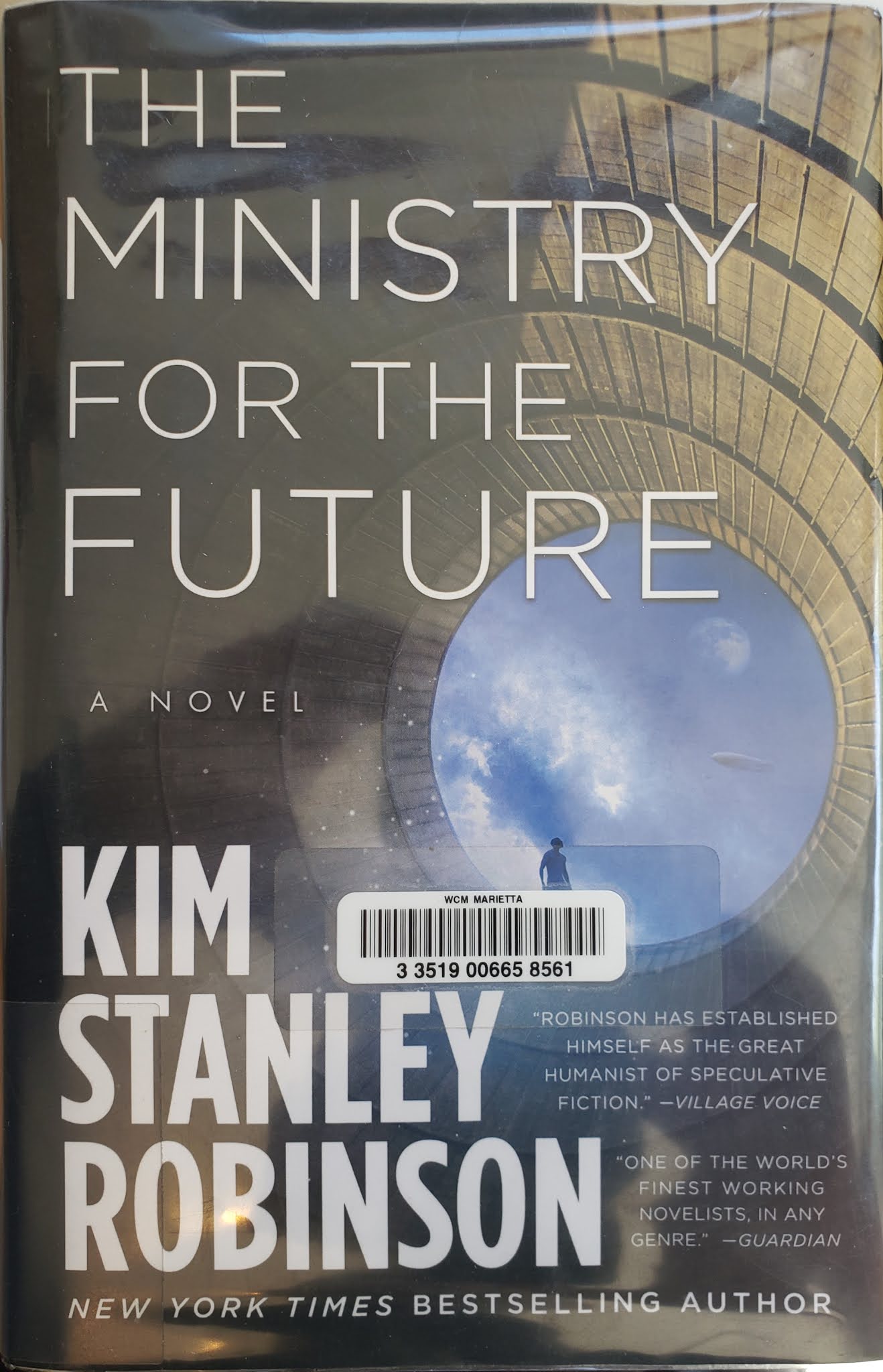
Kim Stanley Robinson seems to write two kinds of books. Both are hard sci-fi in the sense that they focus on either current technology or near-future technology extrapolated from current science. Both kinds of books are quick to locate the political elements of technology and science. While one sort of novel follows in the vein of his Mars trilogy – set in space and looking toward a sort of hopeful exploration (though often fraught with its own political difficulties) – the other kind of novel brings his readers back to Earth to take a hard look at the problems that we face here. The Ministry of the Future is one of the latter kind. While the title makes this sound like a time travel narrative, it is actually about a UN ministry that is established as a proxy for future generations as a way to keep current political entities from taking advantage of as-yet-unborn people. This in itself is an interesting idea because of the broad rhetoric used across the political spectrum in America about the importance of children, fetus, the future, and so on. In this novel, Robinson points out the fact that our systems loves to short the future while also counting on those yet to come to solve the ridiculous problems that we both create and shirk responsibility for.

This novel is a careful bricolage of narrative, ideas for problem solving, international intrigue, meditations on environmentalism and capitalism, and speculation on future technologies and bioengineering. The central narrative of the novel, detailing Mary Murphy's heading of the Ministry for the Future and the attempts she and her team make to bring the Earth back from the brink of destruction, makes up a small portion of the book. Robinson relies heavily on juxtaposition throughout to patch together scenes of striking contrast to highlight the manifold difficulties that we face. This is a necessary tactic because Robinson recognizes that the problems that we face are intricately interconnected.

For as bleak as much of the novel can be, Robinson does find a way to save the world. It takes invention of a new crypto-currency backed by the major economies of the world and based on carbon sequestration and the implementation of many other global-scale projects. But we have to make it through mass carnage and near collapse to get there. The disheartening revelation of the novel is that the wealthy and developed nations must experience the world as others do in order to take action.

I do not find this kind of Robinson's novels as entertaining to read as his space exploration novels, but they are still important to read. Robinson wants to think about a future that is based in the present day and fully cognizant of the problems that we face. He never imagines a future in which humankind is magically no longer like humankind. This can be disheartening, but it is a more useful way of looking at the future.


Monday, October 5, 2020

Book notes, pt. 1

Back in June I decided to take some time off from writing in this blog.  I was still working my old job, which demanded a lot of hours, and I was not feeling inspired to keep up with much.  However, as I kept reading, I made some notes about the books.  They aren’t much, some are just impressions, but this includes some books that I would have liked to have explored more fully in posts.  I thought that I would post a collection of these here and maybe this will inspire me to go back and write more about them.

Note: I ended up with more than I thought for some of these so I decided to split them up.  Here are four of them.

Nightmare in Pink by John D. MacDonald
John D. MacDonald is one of a handful of pulp detective fiction authors who I have spent a lot of time reading.  Writing in the hard-boiled style, his work is similar to that of Brett Halliday, Mickey Spillane, Ed McBain, and others.  They all wrote these short novels about tough-guy detectives who work just outside of the law, sometimes cooperating with police.  The characters are all pretty similar, they are all imposing men who are perpetual bachelors.  They are war veterans who we would probably recognize now as suffering from PTSD.  They all present extremely macho/masculine facades but are well-intentioned and can sometimes expose a domestic or feminine streak.  Their attachments with women are either idealized and distanced or short and intense.  

This novel contains a scene that I have come to find pretty common in these novels.  Travis McGee, MacDonald’s central detective character, is helping the younger sister of a friend of his.  The plot doesn’t matter much because it follows a pretty similar arc to many of these novels.  At one point, McGee helps the sister, Nina, prepare a meal and then clean her apartment.  Nina remarks on McGee’s domestic abilities and how it undercuts his tough guy image.  Then, when she throws himself at him he resists her advances, for a time at least.  

This scene recurs in these pulp novels.  The male figure in these novels is hyper-masculinized to the point that he is able to adopt stereotypically feminine attributes as a point of proof of masculinity.  McGee is so big and tough that he can cook and clean and it doesn’t detract from his properly masculine image.  Also, that act of resisting female advances, which McGee does throughout the book from different women, serves to prove his value at the expense of the women in the book.  He gets to maintain his virtue and good intentions while also eventually sleeping with the woman he desires.  


The Stranger beside Me by Ann Rule
This is the true crime book that sets the standard for a lot of modern true crime stories.  Ann Rule knew Ted Bundy before he became famous for his killings and her book follows much of the investigation through his conviction.  The copy I read has several updates with the last one detailing his execution.

Parts of this book were interesting but I thought it was a bit longer than it needed to be.  Because Rule follows the case chronologically, many details are repeated as investigations and trials in various states commence.  

This book also treads a line that I can find a little worrisome in contemporary true crime stories.  It comes very close to lionizing the killer-subject.  Rule has to walk a fine line because of her friendship with Bundy and can seem at times to tip toward being too complimentary.  She is careful to explain that this is part of Bundy’s game and what makes him dangerous: he was able to hide his dark side and be both disarming and charming.  Then again, I may just be projecting my own ambivalence about the subject.  After all, I did just finish reading a 600-page book about a serial killer.  If Rule is fascinated by this subject, so are a lot of other people (myself included), and a bit of ambivalence to temper the interest/enthusiasm may be the right course.


Rogue Protocol by Martha Wells
Rogue Protocol is the third installment in Martha Wells’ Murderbot saga.  These stories follow a SecUnit that has gained its own autonomy and travels around the galaxy on its own missions, but who ends up helping out humans in need along the way.  Back at the beginning of the plague, tor.com gave away the first 4 novellas in this series to their readers and I scooped them up.  I had already read the first two and just now got to this third one.  

I enjoyed reading it but am a little fuzzy on the details of the book because I read it on my phone during lunch breaks and while standing in line.


Children of Dune by Frank Herbert
The third book in the Dune series left me a little cold.  This novel takes up the lives of Paul Atreides’ family that he has left behind when he went into the desert to, ostensibly, die at the end of Dune Messiah.  The principal family members include: Paul and Chani’s twin children Leto II and Ghanima, who are pre-born, or abominations, depending on the side of mythology you happen to follow; Alia, Paul’s younger sister who is also a pre-born abomination; Duncan Idaho, an Atreides loyal who died in the first book, comes back as a ghola, mentat in the second book, and who is now married to Alia; Lady Jessica, Paul’s mother who has been off-world for a while but returns to Arrakis; Princess Irulan, House Corrino daughter who married Paul at the end of the first book; and Farad’n, the heir apparent of House Corrino who may have designs on the Atreides Imperium.

There is a lot of talk in this book, and a lot of intrigue.  Many of the players are vying for control over the Atreides twins, which would provide control over the Imperium.  There is also some infighting among the Bene Gesserit and the Fremen, and other factions in the Dune world.  A lot of the talk gets further confused by the phenomenon of the “pre-born.”  Alia and the Atreides twins all possess within them the consciousnesses of all of their ancestors.  They have broader views of history and “remember” things that happened before they were born.  Occasionally two characters will dialogue but as different personalities.

One of the more interesting uses of the “pre-born” is to throw personal identity into question.  If Leto II is the conglomeration of all of his ancestors, is there room for his own personality?  Leto II ends up following a path similar to his father, Paul, so he comes to learn his place.  The use of the pre-born trope is also interesting as it plays with destiny and the ability to see the future.

This ability to look into the future using the spice and the effect that it has on people is one of the more interesting aspects of this series.  The Atreides twins are careful to avoid using spice in the beginning of the novel because they fear what it will do to their personalities.  Leto II also begins to fear that knowing the future will doom him along a certain path.  This means that the character is constantly pulled in two directions: toward the past and the influence of the ancestors living inside of his consciousness and toward a future that he wants to carve out on his own, separated from the spice melange.  

In the end, I have to say that I am getting a little bored with this universe.  I think that there are some interesting things going on, but there are also too many things going on.  Like in the preceding books, the reader must keep track of a lot of things that are not really well explained.  Herbert jumps around in his writing and seems to work out details as he goes.  This makes for some confusing reading at times.  

I think I have a copy of God Emperor of Dune somewhere in my office.  If I do, I will read it but otherwise I might be done with the series — though I will probably return to the first book, Dune, and read that again at some point in the future.
Monday, April 13, 2020

The Warehouse

Rob Hart's novel The Warehouse explores a future world in which a Wal-Mart-Amazon hybrid mega-retailer achieves complete market saturation and dominance in a post-capitalist world.  In short, this means that the warehouses for Cloud stores are live/work facilities that operate like corporate owned cities.  Those who are hired by Cloud live within the complex (their board is pre-deducted from their pay), shop at specially designated promenades in the complex (staffed by other Cloud employees) where they pay with "credits" that are roughly equivalent to US dollars (which have been converted for them by Cloud at no fee), and dine at Cloud-owned restaurants (also staffed by Cloud employees).  Each Cloud employee is issued a helpful smart watch that is a personal ID, method of payment, training guide, locator, etc.  So everything within the complexes are a function of employment and are designed to monitor the individual's movements.  The city-stores replace the city-state of old in this world and there is little reason ever to leave the facilities.  In fact, the few scenes narrated outside of the facility show a world that is run-down and on the brink of collapse.  At several points in the novel, we learn that there are very few other employers in the world.  What this means for the economy of this world is that the company Cloud exists to sell to its own employees.  It is a perfect post-capitalist world in which the corporation creates and serves its own demand, serving its own employees and trading in its own corporate scrip.  While all of this is an obvious allegory for Amazon and the tech-giants' corporate campuses, the story itself holds together pretty well.
The narrative follows two recent hires at Cloud; one, a corporate spy hired by an unknown to gather information on Cloud's employment practices, the other, an inventor/small business owner who was put out of business by Cloud's cutthroat practice of undercutting competition and cannot find work elsewhere.  The latter individual, Paxton, had worked at a prison guard in the past and so is designated to work in Cloud security division.  The corporate spy, Zinnia, ends up using Paxton's connections because she is relegated to working in the warehouse as a picker.
There is a romance subplot between the two and the bulk of the narrative is rather predictable, given the setup.  Zinnia seeks to work around the smart watch system to move around the facility with impunity while Paxton unwittingly gets drawn into his own work.
Working in a warehouse myself, I found the author's descriptions of the stocking and picking practices to be inconsistent with how a facility like this would actually be run.  There is a fundamental problem with the logistics that Hart has developed for the novel that would render the whole operation obsolete and completely unable to fulfill the demand that it must meet.  This is an uninteresting aspect of supply chain management that I may answer questions about in the comments if anyone is interested in knowing more but which does not interest me to write about here.  No one not working in a fulfillment center would ever think twice about these things, so it is moot to the actual reading of the novel.
There are two other points I want to hit regarding this novel.  First, Hart creates a pretty interesting analogy in the book about the source of beef for the famous Cloudburgers available only inside the facilities.  It turns out that in this world beef is an expensive rarity enjoyed by only the very privileged.  However, Cloudburger is well known to be of exceptional quality.  The main characters eat these burgers several times throughout the novel before Zinnia discovers their provenance.  Much like Soylent Green, Snowpiercer, and other sci-fi stories before this, the source of food can be a big question.  The Cloud burgers are not made from former employees, as I suspected, but are made from the protein extracted from the waste that the employees produce.  Yes, Cloudburgers are in fact shitburgers.  I like this disgusting idea because it fulfills the notion that the entire novel presents that Cloud serves its own needs.  Recycling the shit of its employees as food seems to line up pretty well with the system of selling your own products to your own employees with your own currency.  Cloud closes the loop in both cases, which leads anyone to wonder how the system sustains itself with no outside input.  This, then, is the central question that the novel presents and which any post-capitalist, dystopian story worth its salt presents.  How does the system sustain?
The second point is the allusions the novel makes to the Ursula K. LeGuin short story, "The Ones Who Walk away from Omelas."  During a trip to the world outside of the Cloud complex, Zinnia runs into a band of scavengers who want to try to break into and disrupt Cloud.  After a struggle and with the bandits retreating, one of them calls Zinnia Omela.  I didn't catch the reference at the time, having not read the story, but Zinnia recalls the story and it makes her rethink her position a bit.
LeGuin describes the city of Omelas where people are happy and carry out their lives at peace but all of the adults know that the price of their peace and contentment is a single child held captive in a cellar beneath the city.  LeGuin doesn't explain why the city works this way but the scapegoat child has reverted to a feral, brutish state and the citizens may not give any comfort.
LeGuin doesn't blame the citizens or moralize beyond mentioning that there are some who leave the city once they have learned of this secret.  So the question remains who might have the moral high-ground here?  Those who walk away simply walk away and choose not to alleviate the child's suffering.  Those who remain take the child's suffering as a reasonable trade for the happiness of a city full of people.
In the context of the novel, this seems to be a question about complicity since all who are inside of the Cloud complex have once been outside of them and know what the conditions are like.  They receive some degree of comfort in their employment and must be content in the knowledge that there are many more suffering on the outside.  The analogy isn't perfect, but it is enough for the novel as it attempts to put the same question to its own readers.

Monday, February 3, 2020

Modern pulp

I picked up Michael Mammay's Spaceside at the grocery store on a whim.  It looked pulpy and it did not disappoint.  Apparently this is the sequel to a novel called Planetside that I did not read, and probably will not.  It isn't that I didn't enjoy this one, but more like I have enough things sitting on my shelf and on my amazon wish list that it seems unlikely that I will feel inspired to make time for this.  However, I do tend to pick books up for worse reasons, so it is always possible.
This was a good quick read blending mystery and thriller elements in with sci-fi.  The main character is a man with a history (if I had read the preceding novel, I probably would not have had to piece so much of it together, but I picked it up) who sets out on a new mission.  He does end up redeeming himself to some extent.
All of this is to be expected.  The thriller and action elements were stronger than the sci-fi because the author seems to really enjoy descriptions of combat strategy, particularly when ground troops are backed up from above.  The movements of his warring groups are precise, whether they are alien combatants or rival corporations.  The main character gets involved in a sort of interstellar corporate espionage plot that gets a little muddled in the middle.
In the end, I liked it but am having trouble remembering details about it even a couple of days after finishing it.

Monday, January 13, 2020

The Expanse, pt. 1: Leviathan Wakes

James S.A. Corey's Leviathan Wakes is a big book that is a part of a big series.  The scope of the novel is equally big.  There is a lot about this author (a pseudonym for two authors working together) and the series (that is currently being adapted into the series The Expanse by Amazon) that merit attention, but I am just interested in this novel so far.
It must have been a few years ago when I started dedicating a lot more time to reading and writing about sci-fi that I started seeing these books.  Initially, I thought that this was an old series because there were so many of them.  Each of the book covers features similar cover art and the same lettering style.  It looks a lot like a reissue of a recovered series.
But this novel, the first in the series was just published in 2011 and the books have been coming out nearly every year with the total up to 8 and a new novella just announced.  So, I had missed the boat a bit until now.
The book opens with a prologue that narrates a terrifying scene of a woman trapped in a storage locker aboard the spaceship Scopuli after it had been forcibly boarded by a hostile raiding party.  Julie, the woman trapped in the locker, will become the center of a shaggy-dog detective narrative around which the sci-fi narrative is wrapped.
The novel's two main characters, Holden and Miller (a disgraced naval officer and disgraced police detective, respectively), carry two separate narrative strands that eventually merge as the case of the missing girl evolves from a wandering daughter case to massive, interplanetary political upheaval.
The exact details of the plot dissolve into the background as the story unfolds.  There is an ancient alien virus, tribal conflict between humans of different colonial origins, and futuristic hardware.  The world built in the novel is one that is familiar to fans of contemporary sci-fi.  That is, a world that is similar to our own in its lived-in qualities.  This is not the glossy world of Star Trek where everything is military-grade and state of the art.  The ships and gear range from the bleeding edge of technology to patched-together, aging industrial haulers.
There is a lot going on in this novel, too much to cover here, but I will say that this was an enjoyable read.  Corey's matter-of-fact description of inter-faction conflict is reminiscent of Heinlein's The Moon is a Harsh Mistress.  In the world of this novel, colonialism travels into space along with humanity as people living in space stations in the and outside of the asteroid belt, on Mars, the Moon, and back on Earth compete for resources and jockey for political power.  The descriptions of the bodies of human that are born and live in different gravities echoes the work of Kim Stanley Robinson, who so frequently muses on the effects that deep space will have on human evolution.
When my recently pared-down sci-fi book group decided to read this novel, I went and bought a box set of the first three novels.  I look forward to continuing this series and seeing what the authors can do with the world they have created.  I am a little torn about whether I want to begin watching the series just yet.  I may hold out until I get further into the books.

Monday, November 11, 2019

Foundation, Part 2: Re-reading Foundation

I meant to sit down and write this post after I finished reading the novel about a week and a half ago but I got caught up in some other writing projects and this fell to the wayside.  What this means is that I meant to give a more in-depth summary and analysis of Asimov's classic Foundation but what you are going to get is more nebulous.  I still have some notes from what I was going to write before, so I am going to work from that.
This may get sloppy and I know that I am going to miss some of the details.  I am okay with that.
This was my third reading of this novel.  The first time I read Foundation was in graduate school when I was working on the encyclopedic novel.  This novel is not encyclopedic, but it does contain thematic elements of the encyclopedia.  This is something that drops out of other novels (as I have written elsewhere) but is pretty heavy in the first one.
The second time I read this novel was with my sci-fi reading group.  We would alternate between reading classic sci-fi and newer novels.  Foundation filled the bill for a classic sci-fi novel that many in the group wanted to read, so we took it up.  I don't remember much about that conversation now, but I probably spent some time talking about the Encyclopedia Galactica.
This third time I am taking it up is with a view toward reading the entire series.
Foundation opens with a couple of really fascinating premises: the science of psychohistory and the aforementioned Encyclopedia Galactica.  I have written about the encyclopedia elsewhere, so I want to focus on psychohistory here.  This science blends sociology, group psychology, and statistical analysis into a science that may be used to predict future events.  The idea is that a properly trained psychohistorian can take a set of data about a current culture and its broad trends and use this to judge the likely outcome of certain events.  Hari Seldon is the most gifted practitioner of psychohistory and he uses it to predict long-scale historical events, including the eventual downfall of the current galactic empire, the dark ages that will follow the fall, and the eventual rise of the second empire.

The science of psychohistory is interesting because it seeks to quantify human action on a macro-scale.  Asimov explains away individual action by relying on probability and using civilization-wide sample sizes to make predictions.  This means the psychohistory relies on the broadest of trends, making individual contributions much too small to be a factor.
In order to show actions on this broad scale, the narrative must make leaps into the future.  This is not an uncommon device in sci-fi, but it takes special care to pull it off.  The author must keep certain thematics steady enough draw along plot and must be careful to re-establish context after each jump forward in time.  Each jump requires new characters as well.  This means that there are a lot of balls to keep in the air at once to pull it off.
Asimov does this with varying success.  The idea of psychohistory and following the plotting of civilization is compelling enough to draw readers along, even as they may have difficulty keeping characters and events straight.  Hari himself remains a constant throughout the narrative despite dying early on in the timeline.  He does this by preparing holograms of himself that are designed to appear at specific times in the future to help guide civilization along its proper course.  Seldon realizes that he must simultaneously nudge civilization in the right direction while also keeping it ignorant of his plan.  This is an unresolved problem of the whole scheme because people begin anticipating these emergences of new information, these "nudges" from Seldon.  Asimov never gets deep enough into the mechanics of psychohistory to deal with this kind of anticipation.  There must be a profound faith in Seldon's prescience for this to be carried off at all.  And this seems to be at odds with the tenets of psychohistory itself.

Ultimately, this is a really enjoyable book.  It is compelling and there is a lot going on.  Asimov is always a big idea author and I am generally ready to forgive the small details that don't always add up.  I tend to think that his characters are generally weak, but again, his are novels of ideas and not character studies so it is easy to set this to the side and enjoy the novel as thought-experiment.

Tuesday, June 4, 2019

ebooks and murderbots

Earlier today while eating lunch I finished reading Martha Well's novella All Systems Red.  The book is part of her murderbot diaries series and this is the first of those that I have read.  The story is narrated from the murderbot's perspective and details one surveying mission that it is contracted on as security.  What is interesting is the kind of self-consciousness the bot has.  It is able to act as a free agent due to a malfunctioning -- and later removed -- governor control but it masks this by behaving as though the restraints are still in place.  The bot is aware of its separation from both the humans and augmented humans around it, but a lot of this separation turns out to be self-imposed because it is wary of its own differences.  There is some sci-fi action but this usually works to underscore the bot's humanity.  I don't know anything else about this series, so I don't know whether or not this is part of an arc or if this is an offshoot.
The story is fast-paced and well-written.  The none of the characters are extremely well developed, but this is fitting given the bot's perspective and attitude toward the humans around it.

I mainly read this book because I had a $5 credit for an ebook and this looked promising.  I have owned e-readers in the past but have gone back and forth on e-books themselves.  There is something about reading a book on screen versus on paper that makes it harder to give my full attention.  The books seem more ephemeral, so I have tried to gear my reading in the same way.  I know that I will want to reread dense or difficult material and that I will be more likely to flip back and forth, so I generally opt for physical books when I know that I am going to need them.  The same goes for books that I know I will want to write about.  I remember enough about this book to provide some impressions, but I would be hard-pressed to go into much more detail than what I have here.
This is something that I have always wanted to get over, but I may be too trained to read the way that I do to break it.  I like the probability and the ability to always have a book or two with me on my phone, but I think I will continue to restrict these books to lighter fare or books, like All Systems Red, that give me a shot at a new author I may like.

Friday, February 22, 2019

A Maze of Death

A few weeks ago I picked up a collection of Philip K. Dick novels and recently finished the first in the book, A Maze of Death.  I have read a bunch of Dick's work over the years and have even taught Do Androids Dream of Electric Sheep, and have always enjoyed it.  I don't have a lot to say about this novel aside from the fact that I enjoyed reading it and Dick does something in it that I have thought about a lot in the past.
In the novel, Dick dumps a bunch of characters into an unfamiliar situation and lets them figure out what is going on.  The narrative builds along with the characters' knowledge, so the reader learns about what is happening as the characters do.  This helps to create in the reader similar senses of alienation and familiarity that the characters experience.  As in many of his novels, the characters begin to doubt the reality of their world and, then, to question their experience of their reality.
I like the idea that there is something to gain from questioning the world we inhabit and that those who do so are not automatically incorrect.  The characters in this novel (largely flat and interchangeable) eventually come out the the VR simulation that has been the entirety of the narrative up to that point, and are instantly aware of the fact that they had placed themselves in the simulation and that they had actually made up the entire world themselves along with the AI running the simulation.
Dick's characters do not always come to a grander revelation, but they usually do gain something from their skepticism, even if that gain is only coming a bit closer to a truth about themselves or their world.
There is a strong similarity between the simulation the characters eventually escape (and subsequently voluntarily re-enter) and Area X in Jeff VanderMeer's Annihilation.  The characters in both novels face a surreality that similarly leaves the reader questioning what is real within the confines of the fiction.  I don't know that both have the same effect in the end, but it interesting to note the possible inspiration for the later novel.  As a part of the "new weird," it would seem natural for VanderMeer to take after Dick.  I just haven't done any research to know for sure.

Monday, February 4, 2019

Children of Time

Adrian Tchaikovsky's Children of Time blends some familiar sci-fi elements such as a generation ship, anxiety of deep space travel and suspension pods, and the search for a new home planet after Earth is rendered inhospitable with some new and surprising direction.  The novel alternates between two narrative strands: the first line details the crew aboard generation ship Gilgamesh travel through interstellar space, scouring planets that had been scouted and seeded by their more advanced ancestors.  The second line follows the development of super-intelligent spiders on one of these planets.  This planet had been "seeded" with a nanovirus that was meant to speed evolution in monkeys that would help to make the planet more hospitable when humans eventually returned to the planet.  The monkeys all died in transit and the nanovirus infected spiders instead.
The super-intelligent spiders angle took a while to grow on me because Tchaikovsky endeavors to tell the story from the spiders' point of view, which can be a little dicey.  However, he does grow into the task a bit more as the story progresses and he moves beyond the initial evolutionary stages and shows a spider population with increasing alien technology.
Aboard the Gilgamesh, the Key Crew members transition in and out of suspension, essentially manipulating time and extending their own lifespans to counteract the difficulties of space travel.  The crew members use suspension and lengths of time to gain advantage over one another.  Essentially, the last one to go into suspension and the first one to awaken have the advantage because they can then control when the others emerge from their sleep.
Toward the end of the novel, one of the primary characters comes to learn that he has been in suspension for much longer than the others and that a lot has been going on.  As the Gilgamesh approaches its goal planet, we learn that key crew members have had children and there have been many successive generations born on the ship.  These generations revert to an almost tribal way of living and the captain of the ship uses suspension to appear once per generation and to create a myth of himself.
There are other surprises in the novel that it is worth checking out first hand, particularly the final confrontation between the Gilgamesh and the spiders on the green planet.

When I began this post a week or so ago, I found myself getting bogged down in plot and detail.  I edited some of that out before finishing.

Saturday, November 10, 2018

Who Fears Death

*I wrote this post a few months back after reading this novel with my sci-fi book club.  I haven't really read it over since then.

Who Fears Death, by Nnedi Okorafor

Nnedi Okorafor’s novel, Who Fears Death, reminds me of a few other books that I have read in my life, and it puts the author in good company.  It reminded me of China Achebe’s matter-of-fact narrative style, particularly in the way that Okorafor describes violence and pain as things that are normal, natural, and to be expected in life.  This treatment actually underscores the impact that violence has on those involved: both on the perpetrator and the victim in different dimensions.  This book also reminds me of Ngugi wa Thi’ongo’s work Wizard of the Crow.  Magic exists in a realistic landscape, but not the magic of wizards and witches.  This is real magic made from human experience and connections to nature.  In this light, it also reminds of of Ursula K. LeGuin’s Wizard of Earthsea and Susanna Clarke’s Jonathan Strange and Mr. Norrell.  But for as much as Okorafor’s novel reminds me of these others, hers is something apart and is uniquely her own.
I read this novel in the context of a science fiction reading group that I host in Cleveland and I think that the context led me to expect a different book. I had been wanting to read this novel for some time, and suggesting it to the group seemed like a good way to make the time for it.  I had been hearing about this novel as a sci-fi or post-apocalyptic novel.  I didn’t find it worked as well with that expectation.  My group tended to agree; they seemed to like it, but not as a sci-fi novel.   There is a sci-fi element, I would add for the sake of full disclosure.  The characters use some futuristic technology that resemble GPS systems and smart phones, but these are outclassed by Onyesonwu’s intuition and magic.  Mostly, the use of technology is glossed over in a society that uses older technology.  There is one passage that sticks out to me and seems to be the main connection to the post-apocalypse:

The Lost Papers go into detail about how the Okeke, during their centuries festering in the darkness, were mad scientists.  The Lost Papers discuss how they invented the old technologies like computers, capture stations, and portables.  They invented ways to duplicate themselves and keep themselves young until they died.  They made food grow on dead land, they cured all diseases.  In the darkness, the amazing Okeke brimmed with wild creativity.

Onyesonwu later thinks of the Okeke as “a sad miserable unthinking lot,” for the embarrassment that they feel about their own past.  This hint of lost technology does fit in with a lot of modern sci-fi that speculates on a world that turns its back on the high technological past in order to regain something human about itself.  But this is also theme that Asimov dealt with, along with many other authors.  

What I like about the novel is that it presents magic as a hard-earned skill.  I tend not to enjoy more traditional fantasy, but I wouldn’t lump this book into that genre, either.  To me, this book picks up on the best traditions it draws from.  The sci-fi/post-apocalyptic tones are there but they are minor.  What they add to the novel is a fresh conflict between modernity and tradition, between the mythic and the realistic.  Characterization is strong and the revenge plot works well to drive the narrative.

Saturday, November 3, 2018

Frank Herbert

I am amazed that I had not read this book sooner.  I suppose it is because I was always aware of the story, had seen the movie and the TV mini-series, and it seemed so familiar that I had never felt the need to actually sit down and read it.  
The story is about what I had thought it would be, which is to say that I had thought my memory of it was spotty and that there were things that I didn’t really know about the narrative, but I discovered that this is actually pretty close to the reality of the book.  For all of Herbert’s creativity and for the massive scope of the novel, there are a lot of holes in it.  I have inklings of the connections between the Houses and why they mimic feudal systems and I have a sense of the political intrigue backing it up, but Herbert does not like to explicitly state much of what is going on.
The narrative itself jumps in time and place without a lot of exposition, which makes the book seem jumpy.  More than once I had to backtrack to a previous section or page, only to realize that the narrative had completely shifted focus, or had jumped forward by 10 of more years in time. 
Beyond the narrative, I found the novel to be more interesting in the ideas that Herbert develops.  One that stands out is the competition Herbert sets up between new and old weapons technology.  At first, the reliance on knives for hand-to-hand combat seems an odd choice in a highly technologically developed world.  But over the course of the novel, the reader finds out that knives must be used to counteract the use of personal energy shields that deflect more advanced weaponry.  Because the energy shields block certain levels of force, the effective knife fighter is not the fastest, but the one who can modulate speed and angles to actually penetrate the shield.  The slower, more subtle energy of a blade can move under the threshold of blocked energy.
The interaction between characters that Herbert creates also helps to develop the narrative where exposition does not.  I had always assumed that Paul Atreides would be a heroic figure in the novel, based upon the David Lynch movie I had seen.  However, Paul is a more conflicted character.  He is something of an embattled figure on Arrakis.  The novel develops his quasi-magical/religious background more than the movie does and it throws a lot more of a pall across the character.  While Paul is always brooding, he is more dangerous in the novel.  Less is revealed about his true motivations and the narrative seems to distrust Paul’s adopted mantle of Muad’dib a lot more than the movie does.  Paul’s place in the middle of the struggle involving House Atreides, House Harkonnen and the Fremen of planet Arrakis is more that of an instigator than the champion of the people I had assumed it to be.
A final point that I had not expected was Herbert’s use of Jewish and Islamic religion in the work.  The novel relies heavily on Abrahamic mysticism, which should not be surprising given Paul’s role as the Prophet. But the nature of prophecy differs from the presented in a more religious context.  
There is a lot more going on in this novel than I care to address at the moment.  I wanted to get some of this down because it has been about three months since I finished the book and I wanted to capture some of my thoughts before they became too hazy.  Don’t be too harsh about those mistakes that I have made.  I wrote this without the book in front of me and with no other preparation than having thought about it for a while.  


I have some of the follow-up Dune books in my to-read pile, so expect to see more on Frank Herbert some time in the future.

Friday, October 26, 2018

Heinlein's moral universe

All of my familiarity with Robert Heinlein's work comes from the last few years.  I have often heard the name and the associations with it, but I did not really have any first-hand knowledge until I came across a copy of Farnham's Freehold (1964) in a small, secondhand bookstore in Cleveland.  The book is Land of the Lost-ish and somewhat entertaining for what it is, but is presents some troubling elements.  The eponymous Farnham is a strong man figure who out-wits and out-matches all those around him, even winning the hand of his ineffectual son's girlfriend as a replacement for his own wife.  There are some standard atomic war fears with a touch of time travel technology thrown in.  Simply, Farnham is transported to a distant future in which a non-white race has risen to power and whites are enslaved.  However, all of those in power are inept and are prejudiced against science, which Farnham uses to his own advantage to gain prominence despite his alien status.
What is more interesting about the book is the way that it interacts with Heinlein's other work.  

The second novel I read by Robert Heinlein is The Moon is a Harsh Mistress (1966), which is a vastly superior novel.  In this book, Heinlein describes a settled moon whose inhabitants share a neocolonial relationship with those still on Earth.  The people living on the Moon are exploited to provide a better standard of living for others and have little say in their own fate.  The protagonist, with the help of an advanced computer, develops a de-centralized network of revolutionaries to free the Moon from the imperialist hold of the Earth.  Whereas Farnham was positioned as a powerful outsider who gains insider status through his novelty and sheer force of will, the protagonist in The Moon is a Harsh Mistress gains power through his anonymity.  He is unsuspecting and only partially in control of his own fate (his computer friend does much of the actual planning and organizational work).  In some ways, Heinlein has flipped the source of power from the strong man to the loose network, or, from the single source of power to the collective.  This latter rendering of power was at odds with my expectations of Heinlein; it seemed out of line with the paternalistic, quasi-authoritarian that I had read about.

Most recently, I read Starship Troopers (1959) with my sci-fi book club and was equally torn over where he actually stands.  Having seen the Paul Verhoeven adaptation of the novel, I was uniquely positioned to understand that this is a novel about guys in space fighting bugs.  Actually, the movie does pick up on some other aspects of the novel that I am not really interested in commenting on at the moment aside from the Michael Ironsides character (I think he plays Sgt. Zim.  I am writing this whole thing from memory, so bear with me on this).  Throughout most of the novel, Rico is a seemingly reluctant soldier who excels in the infantry.  His motivations for joining the armed services is nominally to gain citizenship but are actually more murky.    Rico spends most of the novel in school or in training and it becomes very clear that, in this world at least, that discipline and corporal punishment have replaced touchy-feely liberal values to create a better, more ordered world.  In a class called History and Moral Philosophy, Rico and his classmates learn about the days when social workers would try to understand the reasons people commit crimes, which led to roving gangs and a world on the edge of breakdown.  Their instructor reassures them that floggings have really taught thugs their place and everyone is better off.  The nature of citizenship and the right to franchise are also discussed.  Rico's instructor informs the class that it is right that only those who have served in the armed forces should gain full citizenship and the right to vote because they are the only ones capable of putting the needs of the nation above the needs of the individual.  
This last bit is where I lose the thread, again.  Restricted right to the vote and full citizenship seem more in line with the paternalistic Heinlein but his reverence for community-mindedness (not nationalistic, but more communal, as described in the novel) turns the corner back to the Heinlein I recognized in The Moon is a Harsh Mistress.  

This is a post without an end, an analysis without a conclusion.  I partially think that Heinlein is all of these things, that he believed in a mish-mash of philosophy and instinct that does not always add up.  Another part of me thinks he might just have adopted different ideals for different books in the service of the stories.  Because sci-fi is a speculative genre, he was able to play out different scenarios based on what he was thinking at the time.  Another part of me wants to give up trying to piece together an over-arching view of him as a writer and just take the books as they come.  But where I finally come down, as my training compels me, is to two conclusions.  The first is easy; I need to read more Heinlein.  Beyond this question about his politics, I do like his writing.  The second conclusion is a bit more complex.  There is a tension between the strong individual who wishes to take control of their own fate and the place that the individual has in a collective.  Farnham is a strong individual who struggles against a world that doesn't make sense to him to return to normalcy.  In The Moon is a Harsh Mistress, the protagonist feels allegiance for the community on the Moon against the community on Earth.  He creates a world that relies on the collective power of many individuals united together against an outside foe.  Finally, Starship Troopers demonstrates the extent of the tension in the infantry.  Service to the collective becomes service to self.  Heinlein seems interested in the way that self-interest knocks against other motivations.  He seems to recognize that self-interest sometimes dictates agents to band together or even sacrifice themselves for something bigger than themselves.  This is the central tension that these novels seem to share.  

Monday, July 30, 2018

The Three-Body Problem

I learned about Cixin Liu's The Three-Body Problem trilogy only recently in the sci-fi book club that I help run at the BottleHouse in Cleveland.  To be honest, I didn't know anything about either this author or about Chinese sci-fi before picking up this book.  Although I have been trying to expand my boundaries in this genre, most of my readings still tend to be pretty American, if not pretty white and male.  That may be a topic I can return to later because I want to focus on this first.  Just today I finished The Dark Forest, the second novel in this series, translated into English.  The first book, The Three-Body Problem, begins in Soviet China during the cultural revolution.  The characters in the novel struggle with the oppressive political constraints placed on them from the Communist party while trying to develop their state technology and stay current with the west.  The scientist characters of the novel must constantly temper the direction of their progress to fit with the dominant political ideology.  This is a powerful observation because our conception of an objective science is so pervasive in the United States but we ignore the fact that it is deeply political and politicized, similarly to the way that it is presented in the novel.  While scientific developments in the west are rarely  overtly compared to the tenets of dialectical materialism or some other meta-narrative, scientific avenues are subject to political bias and are subject to falling into and out of mainstream fashion.  There is an illusion of science as a monolith separate from culture that a lot of good science fiction tries to dispel.
In the first novel, scientists in China are able to make contact with a civilization in a nearby solar system.  When the characters learn that the inhabitants of this planet intend on using their superior technology to block further scientific progress on Earth so that they can colonize it, the narrative turns into a mediation on the strategy to overcome the aliens.  This strategy is a part of a long game, though, as the people of Earth learn that it will take the Trisolarans (as they are called) 450 years to reach Earth.
The second novel opens at the close of the modern era at a time when secret strategists are about to hibernate to become "reinforcements" for future generations.  I was worried that this would devolve into a weird time travel narrative, but Liu maintains his focus and reawakens several main characters from the first novel to continue their missions.  They learn, however, that the people of Earth have made some great strides in their technology within the limits still available to them. They have grown confident in their ability to defeat the Trisolarans based on the speed of their ships and the size of the fleets that have been able to build.
While I admit that there are parts of this trilogy-so-far that seem a bit trite or predictable in the world of sci-fi the novels do offer some genuine surprises in their inventiveness.  The first-contact narrative does not go according to the old tropes and there are some interesting turns in the second novel.  It gets bleak at times, but this is part of the enjoyment.  As I mentioned at the top, I just finished the second novel in the trilogy, and I am completely uncertain where the final one will go.  These books have surprised me and they turn on the expected sci-fi tropes.

Tuesday, July 24, 2018

I used to live in an apartment building where I would find old pulp sci-fi books in the laundry room.  Many of these I would read and then return to the shelving in the basement, but I collected and kept a number of them when I moved out so that I could continue to read them.  I left behind a number of my own books to pay back the small library.  I read a number of novels that I enjoyed: Joe Haldeman's Forever War, a couple by Mack Reynolds (After Utopia and  Satellite City), Out of Time by James P. Hogan, and Level 9 by Mordecai Roshwald.  All of them are pulpy but have interesting ideas, and some are better written than others.  I read a few that I didn't care for -- Them   by Robert French topping the list --  and Philip Wylie's The End of the Dream was one of them.
The novel's concept is to present a collection of evidence from a future world that reflects poorly on the environmental policies of the current day.  The novel came out in 1972 and posits the year 1975 -- a long-past date in the present time of the novel -- as the point of no return for humanity before crisis.  There isn't much of a plot or any kind of character development.  Wylie tries to humanize it a bit by including two characters who head up a sort of futuristic conservation league, but the confines of the epistolary format keep them uninteresting and undeveloped.  They are only names at the bottom of blocks of text.
The novel is a sledge-hammer and it is worse for it.  I am all for sci-fi novels that use the future as a means of critiquing the present, I think sci-fi at its best always does this, but this is just too far.  There are burning rivers and plagues.  It might line up with biblical plagues of Egypt but I didn't end up caring enough to find the parallels.
The opening pages of the book contain blurbs about Wylie's greatness.  I know that all books have these, but I am curious about the author's other work.  He seems to have a good grasp of the science of the day and has some imagination.  One of the more vivid reports is the narrative of a fisherman who witnesses hyper-evolved salt water leeches that can travel onto land and attack humans and other land mammals.  This is actually one of the more developed scenes and characters in the novel and it makes me hope that Wylie can do this on a sustained level when on less of a mission than he was with this book.
Most of the book leads from the darkness of 1975 when things can no longer be fixed to some point in the 21st century that is the narrative present.  At that future point, things are looking up and the remainder of human society that has not been killed off in some horrific way have recreated civilization and want to move forward.  It all ends with some shocking news I can't quite recall and refuse to look up even though the book is within easy reach that all of their efforts were for nothing and the world is actually going to end again, probably for real this time.
This book was not really enjoyable and I glossed over large portions of it because they were the kind of faux-technical writing that is extremely boring and not at all informative.  The cover, I think, is more interesting than the book.