Monday, March 2, 2026

Book Notes - 3 so far

 At the start of the year I had an idea for a book project I have been thinking about for some time. I don't think that I am going to go for it quite yet, but I have been wanting to get back into writing about books on this blog. I am going to keep the project under my hat for the moment in case I do decide to start it up in the near future. 

However, I do want to shake off some of the dust and start posting again, so I thought I would do a few quick notes about the books that I have read so far this year as a way to motivate myself to keep coming back.

 Kill Creek by Scott Thomas was recommended to me by a colleague who shares an interest in gothic and horror novels. This book is a few years old at this point but I had not heard of it or the author. I have been more interested in postmodern horror over the last couple of years and have been working on a couple of scholarly projects involving the genre lately (perhaps more on my conference presentation upcoming?). After reading the synopsis, I was excited to start reading this book.

This starts out as a haunted house story that brings in tech media and internet fame. A young tech bro running a horror fansite -- which he insists is so successful that it is actually just a pop culture site -- invites 4 horror authors to a curated event in this haunted house to livestream a group interview. Each of the authors brings their own personal baggage with them, experiences weird things, and then heads home. The novel takes a turn here in an interesting direction. Upon returning home, each of the authors becomes obsessed with writing a new novel about the house that they were in and, upon checking notes with one another, discover that they are all writing the same novel. 

I won't reveal what happens next here for the sake of anyone interested in reading this novel, but I will say that this was a suspenseful and exciting novel to read. Thomas' work plays with the conventions of the haunted house story, blending in the personal demons that each of the authors in the book contend with. The read is fun and the ending took me by surprise in a way that I have not experienced in a long time. Definitely worth the read.

 Famous is the latest work by Blake Crouch. I have enjoyed Crouch's work for some time. I think Recursion  was the first novel I read and I have worked my way through the Wayward Pines series and several other stand-alone novels. This novel breaks tone and genre from a lot of his prior work. I have come to expect carefully crafted time-travel plots or some other sci-fi adjacent work but Famous strays from this. To be honest, this read more like a Chuck Palahniuk novel than it did a Blake Crouch one. The cover of this novel boasted an A24 movie adaptation which, sorry to say, I won't be watching. This book didn't do it for me. I have read better from Crouch and I hope to see a return to form in future novels.

Finally, I took a recent read through an older book: Manhood for Amateurs by Michael Chabon. I have read a lot of Chabon over the years and have always liked his work for its attention to character and devotion to pop culture fandom. I was blown away by The Amazing Adventures of Kavalier and Klay when I first read it in graduate school. This book is not a novel but a collection of essays loosely centering on the topic of a gen X author reaching middle age and reflecting on his life. This topic, as a somewhat younger member of gen X reaching middle age and considering my own relevance, is one that I find sympathetic. Chabon writes about his experience parenting and attempting to expose his children to art and music that he enjoyed, he writes about his first experience carrying a diaper bag while still wanting to appear masculine. One of the essays that hit me the hardest was one in which he describes briefly meeting David Foster Wallace at a Democratic party event. In all, the essays work as an expression of the time. Some have aged better than others but the book was worth a read, overall. It would probably work best for the demographic I fit comfortably into and might have limited returns venturing outside of that.

Friday, January 24, 2025

On uncertainty and new beginnings


It has been some time wince I have posted anything here: just a shade over 2 years to be precise. I posted a list of the books that I read in 2022 at the end of that year and it has been silent here ever since. I have started posts that I never finished. I have thought a lot about what I might put here and I thought a lot about the direction that I wanted to take with this. All of these meaning that I never did anything with it.

Since the fall of last year, I have found myself in a new job. I almost stumbled into a full-time teaching job at a community college. This was an unexpected step for me. Though I have been teaching college English for quite a long time, most of that has been part-time, and almost all of it has been fully online since about 2016. I didn’t think that a job like this was in the books for me and I had stopped looking for this kind of work a long time ago. I won’t go into details here about how the job came about, but suffice to say that the change has been good.

In the last 2 years I have read as much as I ever have, but I didn’t feel the drive to write about anything. But that is returning to me. I have two different academic projects in the works that I will wrap up in the coming months and I think I am ready to restart writing here.

I don’t know with what regularity this will happen, but I am making myself write this as an act of explanation to myself and as a motivation to keep this up. I do enjoy doing this but I am out of practice.

Saturday, December 31, 2022

2022 Books


I don't write about all of the books that I read. Here is a list of the books that I read in 2022.


Abrahams, Peter. A Perfect Crime.
Adams, Douglas. The Hitchhiker's Guide to the Galaxy.
Alworth, Jeff.  The Beer Bible.
Anderson, Poul.  The Boat of a Million Years.
Asimov, Isaac.  The Currents of Space.
---. The Robots of Dawn.
---. Robots and Empire.
Babineaux, Ryan & John Krumboltz. Fail Fast, Fail Often.
Bowlin, Barrett. Ghosts Caught on Film.
Butler, Octavia. Parable of the Sower.
Cantwell, Dick. The Brewers Association's Guide to Starting Your Own Brewery.
Cham, Jorge & Daniel Whiteson. Frequently Asked Questions about the Universe.
Corey, James, SA.  Leviathan Falls.
---. Memory's Legion.
Crouch, Blake. Pines.
---. Recursion.
---. Wayward.
---. The Last Town.
Dick, Philip K. Paycheck and Other Classic Stories.
Doctorow, Cory. Walkaway.
Freud, Sigmund. Five Lectures on Psycho-Analysis.
Haldeman, Joe. Camouflage. 
Hill, Joe. Horns. 
Jackson, Shirley.  Hangsaman.
King, Stephen. If it Bleeds.
King, Stephen & Peter Straub. The Talisman.
Lem, Stanislaw. Solaris.
Lewis, Sean. We Make Beer.
Neuvel, Sylvain.  A History of What Comes Next.
Nevala-Lee, Alec.  Astounding: John W. Campbell, Isaac Asimov, Robert A. Heinlein, L. Ron Hubbard,         and the Golden Age of Science Fiction.
Odenkirk, Bob. Comedy Comedy Comedy Drama.
Papazian, Charlie. The Complete Joy of Homebrewing.
Paretsky, Sara. Overboard.
Quindlan, Anna. Write for Your Life. 
Rimbaud, Penny.  The Last of the Hippies.
Robinson, Kim Stanley.  Green Mars.
---.  Blue Mars.
---. The Martians.
Scalzi, John. Kaiju Protection Society.
---. Old Man's War.
---. The Ghost Brigade.
---. The Last Colony.
St. John Mandel, Emily. Station Eleven.

Friday, December 30, 2022

Consider the Author

 This is something that I started writing some time ago and I think that it has legs but I lost track of it and just never finished it. As of now, I am not interested in finishing this, but I want to post this because I think that I make a few good observations here and it is hard to throw away a piece of writing like this once it has begun. It's my blog, so that's it.

Parts of this are a little rough and some places I just leave off because I was just jotting down notes. There is one point at the end that I will comment on after the text that I have written.

So here it is, another unfinished essay about David Foster Wallace.


Consider the Author

I have written a lot about the work of David Foster Wallace in my academic career and elsewhere. He has always been something of a problematic figure for me because there is a great deal of his output that I have enjoyed but there has always been a kernel of something that is at the heart of it that gives me pause. If this were a piece of my academic work, I would take the time to work this all out ahead of time and treat you to a thesis claim. But since you are reading (maybe) this on my personal blog, I am going to write for exploration and maybe figure out what I mean by the end of it.

There is something about Wallace's work that has started to chafe at me. Still, there is much about his work that I enjoy, so I have found this to be a difficult relationship. I have written about my early experiences reading DFW elsewhere, but it bears repeating in brief here.

When I first read his work I hated it. I picked up Oblivion on the recommendation of a friend (he didn't recommend this book in particular, just that I read DFW's work and this is the one that I selected). I hated it. The overly detailed exactitude of his descriptions and the seeming lack of emotional depth turned me off and I quit reading. After further coaxing I picked up Infinite Jest and struggled through reading it over the course of about 8 months. This novel was less jarring in its minutiae than the stories in Oblivion but I still just didn't get it, didn't like it. But I kept thinking about. For the next two years I thought about that book and discussed it with whomever I met who had also read it (even in my doctoral program I found few who had made it through the whole of it). I eventually picked it back up to read again and had a very different experience. I loved the novel for a number of reasons. There were parts of it that still rankled, but I like the the experience of reading it and what it seemed to stand for. On that first read-through I had missed a lot of the post-/anti-ironic elements and I missed the true suffering that Hal faces. I, as I found others would too, had misread the character and read Wallace's descriptions of Hal's postmodern detatchment as endorsement rather than diagnosis.


I come to this point in my writing now because I have picked up DFW's Consider the Lobster, one of his collections of essays. The background here is that, with the exception of Infinite Jest, I have always preferred Wallace's non-fiction to his fiction. This is going to figure into my summation later. But what I noticed while reading the first essay in this collection, “Big Red Son,” is that it just drips with smarm.


“Big Red Son” is the first essay in the collection and it details Wallace's attendance at the Adult Video News awards, porn awards. While there are some amusing observations throughout, one really gets the sense that DFW is congratulating himself throughout for the edginess of covering this subject. Wallace attempts to give the subject the serious treatment that he implies that it deserves while simultaneously making fun of the people involved for their earnestness in their profession and undercutting his reportage at nearly every turn. Wallace's signature style is to insert himself into his own journalism and he casts himself as a sort of gee-shucks regular Joe that he does in much of


One of the big problems that emerges in DFW's work is a self-assuredness in his perspective as some sort of “outsider.” Wallace adopts a particular tone in which he assumes authority on select topics because he is a combination of a) being young enough to understand youth and youth perspective; b) being educated enough to view this perspective critically while also tapping into traditionalist views; and c) aware enough of the irony of the confluence of these positions to comment on all of it. The difficulty is that he then often writes himself into blind spots that seem to confirm the negative assertions of his critics.

Let me give you a specific example from the essay “Authority and American Usage,” a review of a style guide that ends up a polemic on English dialects and the role of proper English. I will note that I do agree with much of what Wallace writes in this essay and it is, overall, an extremely fine argument about the political role of language as political and cultural signifier. In one aside, Wallace strives to tell his reader what the problem of “politically correct” language is. The problem, for Wallace, is that it amounts to self-congratulatory virtue signaling on the part of the Left. But Wallace seems to go out of his way to provide examples in bad faith, referring to the poor as “economically disadvantaged” and eventually “pre-prosperous.” His examples tend to follow in the footsteps of many conservative critics who would demean “PC” by just making things up that no one ever actually said and then pointing at their imagined examples as subject of ridicule. This is poor argumentation. But there is a more serious flaw. In the pages leading up to this analysis, Wallace off-handedly uses the word “fag” as


This is where I ended it. I wanted to pick back up here because I remember the point that I was moving toward and I think that it bears finishing that thought, at least.

So what rankled me about this is not that Wallace has a dislike for what he calls PC language or that that he uses a slur in a denigrating way. What bothered me then, and what I still think about, is that in this essay that is supposedly about the political power of language, Wallace ignores the power of language to damage and dehumanize others. I don't think that he means to be hurtful by using the word “fag” in such a way, but that is what he is doing. By not thinking about his usage in this way, he participates and promotes a homophobic agenda.

This is disappointing because Wallace is typically a very thorough thinker and this seems like a real gap in his reasoning that is surprising to read now. It is also disappointing because Wallace is typically such an empathetic writer.

Friday, December 16, 2022

Book Notes

 I wrote this some time last year or the year before. I'm not sure when this is from, exactly. I am posting without further comment.

Island in the Sea of Time – SM Stirling

This is a series that I have known about for some time and I read the opening novel of the sister series about a year and a half ago. Without being too glib about it, I will just say that these books aren't for me. They straddle the line between SF and fantasy and I think that they end up being a bit on the fantasy side of things for my tastes.

The basic story is that the island of Nantucket is inexplicably transported 3000 years into the past and the islanders have to figure out how to survive. I like the concept. Stirling really gets into details on various aspects and has a very broad view of the world he wants to remake. I don't fault his vision or the writing. I just don't particularly care for the kind of tactical writing that he gets into. There are a lot of descriptions of fight scenes and war tactics that don't do it for me. For the right person, though, I can see this being a fantastic series.


Lincoln in the Bardo – George Saunders

I'm not sure I get George Saunders anymore. I wonder if I ever did.


The Bone Clocks – David Mitchell

I first read David Mitchell's Cloud Atlas when I was in graduate school. That is a nesting novel that interlaces several different characters and settings into a sort of cosmic return/cycle/metempsychosis that is pretty entertaining but unravels after one particular narratological mis-step that I won't get into here.

The Bone Clocks revisits some of the themes and narrative techniques featured in Cloud Atlas. Characters called “atemporals” live outside of time, fight an unseen war, and influence mortal humans around the world. Pretty good stuff. The opening sections of the book serve as character studies for the principal characters that will influence the latter half of the novel and the way that Mitchell interlaces their stories is confusing at first but comes together as the novel progresses.

While I found myself getting a little lost in the particulars of the individual characters I did enjoy the leaps in time that occur throughout the novel. Mitchell predicts a future Ireland in the “Endarkenment” after some cataclysmic event forces much of humanity back into a mostly pre-technology existence. I ended up liking the near-future predictions a bit more than some of the other aspects that ran a little more fantastic. This ends up being a better novel than Cloud Atlas and a better representation of some of the same ideas.


Riot Baby – Tochi Onyebuchi

This is a fantastic novel that blends near-future carceral dystopian elements with just enough fantasy to keep it going. The meditations on the impacts of violence on physical and psychological beings are moving and inspiring.

Read it.


How to Survive a Robot Uprising – Daniel H. Wilson

This is an odd little book that came to my attention recently. Over the last couple of years I have been trying to read more pop science books. This book came up on a list and so I requested it through the county library. This book is actually a guide to surviving a robot uprising. It includes some meditations on current technologies (well, current as of its publication in 2005) and how to evade, defeat these things. It is billed as a humor book as well, and it has its moments. I burned through the book pretty quickly because much of it is laid out in very small sections. Interesting book but I have the feeling that it will soon be completely obsolete if it is not already due to the rise of smart phones and all of that attendant technology. It would be cool to see an update of this written with more contemporary tech in mind.

Friday, December 2, 2022

Restarting.

It has been some time since I have posted anything here. I am, optimistically, going to set myself up to begin posting again. There are some books that I have read in the last year that I wanted to write about but I think I missed the boat because it has been some time since I read them. Some of them I may try to work back to them regardless.

As I draft this and think about getting started again, I also think about the ebb and flow of my interest, my energy, and my motivation. These things change over time and I often find myself being drawn back to old projects. I do have a different project in mind that I am not quite ready to reveal yet. It is something that I have been working on for quite some time (off-and-on) and that builds upon some of my previous work as well. It is a project that really energizes me when I think about it but it is also big, so it can overwhelm me as well.

Before this gets too long, I will just note that I am excited to find my motivation to write here returning. I will keep this flame stoked as long as possible.

Friday, December 31, 2021

Ending another year.

I am ending out 2021 without ever having returned to the blog. After all of the changes of 2020, I had high hopes for 2021. I won't say that it was worse because I don't think that it was. Instead, I will say that it was different. The successes and challenges were different. The second half of the year particularly presented a number of challenges for me, but it also brought a lot of hope as well. I won't get into specifics here but those who know me will be aware of what all of this means.

I do hope to begin posting again in 2022. I'm not sure when, how often, or in what capacity, but I do want to make a return. Be on the lookout. I may eventually finish up some of the series that I have started and begin writing about some new topics. Check back, or just wait for my annoying social media posts.


2021 Books

 I don't write about all of the books that I read.  Here is a list of the books that I read in 2021.

Asimov, Isaac.  Forward the Foundation.
---.  The Complete Robot.
---.  The Caves of Steel.
---.  The Naked Sun.
Christensen, Emma.  Brew Better Beer.
Cline, Ernest.  Ready Player Two.
Corey, James SA.  Babylon's Ashes.
---.  Persepolis Rising.
---.  Tiamat's Wrath.
Cronin, Justin.  The Passage.
DeLillo, Don.  Libra.
Farina, Richard.  Been down so Long it Looks like up to Me.
Frye, Northrop.  Anatomy of Criticism.
Goldberg, Lee Matthew.  Orange City.
Haldeman, Joe.  The Accidental Time Machine.
Halliday, Brett.  Heads You Lose.
Kaku, Michio.  Physics of the Impossible.
King, Stephen.  The Outsider.
Koch, Greg and Matt Allyn.  The Brewer's Apprentice.
Kunath, Brian.  Fearless Brewing: The Beer Maker's Bible.
MacDonald, John D.  The Deep Blue Goodbye.
---.  Man-Trap.
Martinez, A. Lee.  The Automatic Detective.
Mitchell, David.  The Bone Clocks.
Onyebuchi, Tochi.  Riot Baby.
Palmer, John J.  How to Brew.
Powers, Zach.  First Cosmic Velocity.
Robinson, Kim Stanley.  The Ministry for the Future.
---.  Red Mars.
Rowling, JK.  Harry Potter and the Chamber of Secrets.
---.  Harry Potter and the Prisoner of Azkaban.
Saunders, George.  Lincoln in the Bardo.
Spillane, Mickey.  The Girl Hunters.
Stirling, SM.  Island in the Sea of Time.
Sturtevant, Lynne.  Haunted Marietta.
Wallace, David Foster.  Consider the Lobster.
Watt, James.  Business for Punks.
Wilson, Daniel H.  How to Survive a Robot Uprising.
Woodske, Dan.   A Brewer's Guide to Opening a Nano Brewery.

Thursday, June 24, 2021

After the Quarantine

 This is the text of a talk that I gave at the Working-Class Studies Association conference earlier this month.  This concerns the working conditions of Adjunct Instructors and the shape of virtual pedagogy today.

After the Quarantine: Virtual Pedagogy and Virtual Workspaces in a Post-Pandemic World”

When I sat down to write out the introduction to the presentation that I am going to give today, I realized that it has been about a year and a half since I initially submitted my abstract. Back in January of 2020 we all had hoped to meet together in person in Youngstown but the events of the last year prevented that from happening. Those events have also changed the context of what this paper would have been. I set out to write about the realities of teaching online-only classes for adjunct faculty members and the difficulties that this presents. But then pretty much all of us turned into online-only teachers and a lot of what I was going to say became very obvious to everyone. Of the two main points that I wanted to touch on from that abstract, one of these has been completely obviated by the pandemic that quarantined all of us. The other point, though, is more valid now than when I originally sat down to plan my abstract and it is about the interplay of virtual pedagogy and adjunct labor. This paper, originally about the virtual space that adjuncts must occupy on the edge of the academic world will now, itself, occupy a liminal space. As I worked on this presentation today, I found myself bouncing between the paper that this would have been had I presented it in Youngstown a year ago and what it is today.

Here are the two points I originally wanted to make: first, adjunct teaching is often an under-resourced and thankless job and it is easy to fall under the radar. This is made worse by teaching online only because we are also absent from campus and miss out on a lot of the opportunities to network and maintain important peer relationships that on-site teachers have.  We must also use our own resources to perform the work without any compensation for this.  Here I mean things like electricity, internet access, and the like.  I think that most teachers have felt this way after a year-plus of online teaching so I will not really address this point today.

The second point is less obvious but isn't much of a stretch to get to: adjunct teaching, and teaching online only presents a bind that looks like an opportunity for many academics who hold down multiple jobs. Many academics such as myself teach online in order to keep current teaching experience and avoid gaps in our CVs. Many are trying to earn a living by patching together multiple part-time positions while trying to wrangle the job market and find a full time appointment. The flexibility of asynchronous teaching allows us to take on other work to supplement our incomes. This flexibility also looks like an opportunity to do the necessary work to build our CVs such as attending conferences and publishing, but the work we do whether it is in the classroom or in our other jobs generally is enough to keep many of us from being able to do this as much as we would like. The allure of the freedom to continue teaching while pursuing other work and earn extra money ultimately ends in a narrowing of opportunities that works to keep these instructors in adjunct positions, or to make the decision to leave academics completely.

My original paper would have outlined many of the details of this bind and would have offered some suggestions for overcoming this difficulty.  But instead I want to veer a little off course from my original plan. Instead of talking about the nature of online adjunct teaching and the difficulties that this presents, I want to expand my scope to discuss the nature of virtual pedagogy and to take a look at the future of education.  I think that this is important because this is a crucial moment in which we can take the time to rethink how we interact with our colleagues and to re-examine some of the values that we have taken for granted in higher education. This is a moment to push past limiting views of what virtual pedagogy should be to think about what virtual pedagogy could be.

Prior to the pandemic, I had worked myself into a niche with my online teaching experience. I taught my first online courses in 2010 and have been teaching online only since 2015 and I have learned a lot from having to revise my curriculum to meet the needs of my virtual classroom. At this point, I have taught scores, if not hundreds, of students whom I have never met face-to-face, and would never know if they were to pass me in the street. Yet we have shared a space together and worked together. They have told me about important things in their lives and I have told them about myself. I have endeavored to gain their trust and to build rapport through the course structure and the public and private communications that we shared. I have developed some specific strategies for doing this that have helped immensely.

I think that my transition to teaching online has largely been successful and I have become a better teacher for having to re-evaluate some of my assumptions about learning and communicating expectations. But for all of this, online teaching always had a cloud over it.  Some of my students did poorly because they were unable to manage their time the same way that they would in a traditional classroom.  They didn’t feel the same sense of accountability because they didn’t have to walk into a physical classroom and tell a real person that they hadn’t done their work.  Others took my classes because they thought it would be easy since it was online and “not a real class.”  I know this because some of them have admitted this in their end of semester evaluations. In those same evaluations, students have commented on the difficulty of my class or expressed surprise at actually learning something.

My students often commented on the workload in my courses and on the number of readings I assigned. One exercise that I use is to provide my students with a forum for offering suggestions to improve the course or to critique parts of the course they find unhelpful. In this forum, students would complain about the number of readings or about the work that I assigned. What they don't know is that I have cut a lot of readings that I would assign in favor of having them produce and express their own ideas. They also didn't know that I have streamlined the writing process so that every assignment that they complete contributes directly to larger projects and guides us toward our learning outcomes. I trimmed out what I have come to think of as extraneous work. In other words, some of my students were unhappy with the amount of work that I asked them to do even though it was less than what I asked my students to do in a more traditional setting.

But here's the thing. The problem wasn't with the work that I was asking them to do. The problem was the work they were being asked to do for an online class. I know this because I have gotten end of semester evaluation with phrases like “for an online class” in them. Students are surprised to learn in an online class, surprised that it can be helpful, surprised that they had to work in one. There was a disconnect for them such that taking a class online was not the same as taking a class in a physical space. And again, I know this because I have had students tell me this. What this indicates to me is that, up until now, we have done a poor job preparing students for the demands of an online class. We haven't shown them that a virtual classroom is a real one even though it is not a physical space.

I want to go back and take a moment to explain the original title because there was a metaphor in it that I was going to use. My paper was originally titled “Navigating the Virtual Zone.” As I worked on the abstract for that original paper, I had the idea of drawing a metaphor from my work. At the time, I was working in a regional distribution warehouse for a national hardware store coop doing inventory and quality control. The specifics of the job are unimportant. But what is important to my way of thinking about it is the way that virtual mapping is used in the warehouse. The WMS (warehouse management system) that we used is actually a layering of systems of varying age.  The warehouse was built in 1977 so all of the inventory was kept on paper and then eventually it moved into computers and as the computers and the programs that the company bought became more sophisticated, they found that it was easier and less expensive to overlay the new programming on top of the old rather than build a new system from scratch.  This lead to gaps between the layers that were only discovered later on.  Eventually, the programs that were built in the 1990s and earlier were unable to keep up with the new order-filling assignment programs that were installed in the 2000s and to bridge this gap, the system constructed “V-zones” or virtual zones that are virtual computer mapping of physical space. It is the stopgap that allows the mainframe to give instructions to workers in a physical space. But the stopgap became a permanent solution.

In my job, I had access to number of these different systems and I had to find ways of using the different systems to find information where there were gaps in one or the other. I became highly aware of the limitations of the overall system because there was no way to navigate it holistically but it had to be approached piecemeal. I adopted the metaphor of the virtual zone for this paper for two reasons. First, the “virtual” nature of the warehouse mapping seemed to match up pretty well with the “virtual” classroom. Both virtual spaces correspond to actual work being done and describe a certain relationship between the physical space and that work being done. Second, and more importantly, I saw the overlay of multiple systems in the WMS as parallel to the expediency-driven stopgap that is virtual teaching. This is not a system that has been built from the ground up to take its unique challenges into account. Instead, it was a thing that was thrust upon many teachers with little to no training. I don't know if we have the ability to undergo a wholesale revamp of higher education in America but we at least need to recognize the overlay of systems and really examine where they do not mesh.

If I have anything like a thesis to argue today, it is this: we are at a critical juncture in our educational careers and in our lives in general. As we move back toward unrestricted life we can choose to return to “pre-pandemic” life, a return to the normalcy where faculty members such as myself find themselves without a place at the table, or we can take this opportunity to recognize that the difficulties that all of us faced during quarantine were not new for many of us. The isolation and disconnect that has lasted for a year for some of us has been an ongoing problem for many of us for much longer than that. We can also extrapolate this to our relationships with our students and use this same isolation as an object lesson in what some of them have felt like for their whole lives. Then, I hope, we can use this to also think about our lives out in the rest of the world. We have to seriously question whether or not “pre-pandemic” is good enough. I don't think that it is. I think that there is an opportunity here to do better and to be better.

Until now, virtual teaching was largely seen as an adjunct to traditional teaching. I use the word “adjunct” very deliberately here because of what its true meaning is and the impact that it has on our colleagues. To be adjunct is to be supplementary. It is, by definition, non-essential. Virtual learning had been non-essential until it wasn't. As so many of us know, adjunct teachers are anything but non-essential. We are the essential workers of the academic world. In the post-pandemic world, we have to question whether or not we can afford to return to this “pre-pandemic” way of thinking. My argument, then, is that we cannot. My argument is simple but it needs to be stated to be clear. I do not think that a return to normalcy is good just as I don't think that all aspects of quarantine-driven changes to education have been bad. In some ways it has caused a reckoning of how others live and work. As I stated above, I think that we can do better. My argument is that we need to continue the work that we have done over the last year in re-thinking our strategies in teaching and our relationships with our peers and students. We need to use this as a starting point and not as a point of return.

In the interest of doing better, I have thought of some suggestions to carry forward with us when we return to our respective campuses and other places of work. These suggestions are based upon a lot of the things that I have been thinking about while working on this paper and sum up some of the difficulties that I think may face us going forward. This list only has four items but I think that this is a start toward being more deliberate in our engagements.


1- Zoom meetings and asynchronous pedagogy have leveled the playing field in some respects. It can mean that students who have difficulty with some subjects or don't know how to ask questions about things they don't understand will have the opportunity to learn in a different modality. Asynchronous teaching specifically can help students to ask the questions that they may find intimidating to ask in class because they are worried about their peers' judgment. We should be ready to embrace these styles of teaching going forward and ask what our connection to the classroom is and what it should be. I still think that the classroom is an important site of learning, but it does not have to be the only site.


2- Think about what participation looks like in different modalities. This doesn't just mean classroom participation, but it can include this. What opportunities are there for students to be active in student life that do not require a physical presence on campus? What opportunities are there for adjunct teachers who are either on-site or online to engage with other faculty members and to network? This is a time when we can think about all of the virtual events that we have participated in over the last year and ask if this makes our institutions more diverse and accommodating.


3- We need to be sure that we recognize virtual work as real work. Teaching online requires a lot of the same preparation that traditional teaching does and it also requires a great deal of special preparation. The needs of students in a virtual classroom will be different from those in a traditional setting and we have to take the time to re-adjust our thinking to accommodate this. This means that we also have to work to teach our students how to make this change as well. We cannot assume that they know how to navigate our virtual spaces or that they will know where to find instructions. Also, being clear about what students can expect from us is vital. When not working around class schedules students may try to reach out at odd times and expect immediate response. Being clear about our working hours is a useful way to avoid the creep of work taking over our personal lives and reinforces the concept that staying in communication is work for us. The converse of this is that we need to be vigilant in teaching our students that the work that they do in a virtual space is also real work.


4- I think that this is a key moment for all of us to examine the difficulties that we have had over the last year and to really reflect on what it means to go back into a physical classroom. As teachers, we have had to overcome a lot of difficulties, and our students have done a lot to meet us there. We need to recognize that the massive educational shifts that we have undergone have also served to decontextualize our work. This means that we are in better positions to examine the assumptions that we brought with us to the classroom. This is a point where we can question the status quo of higher education and be deliberate in how we move forward.


Monday, May 24, 2021

Imagining Earth's Future

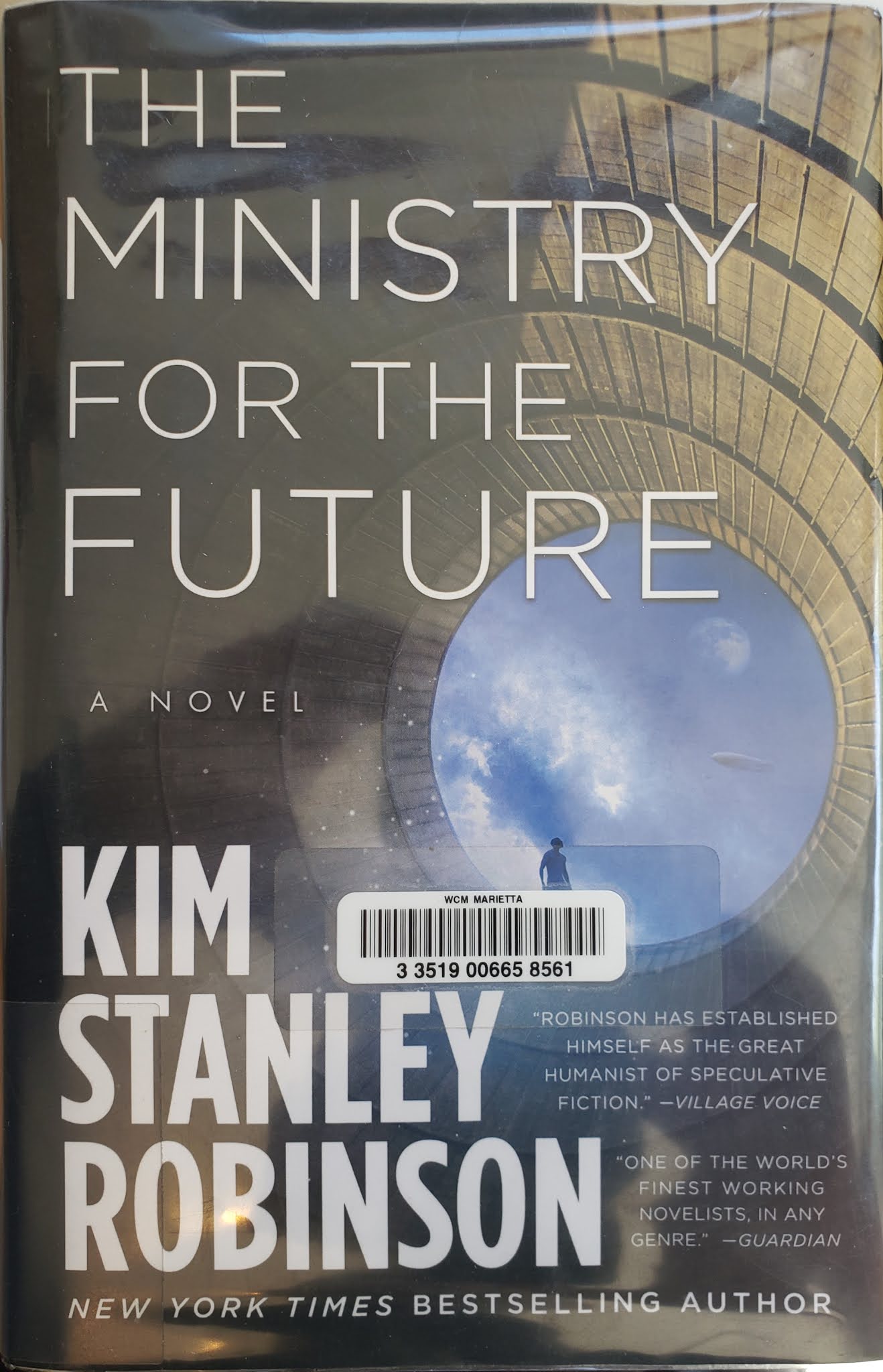
Kim Stanley Robinson seems to write two kinds of books. Both are hard sci-fi in the sense that they focus on either current technology or near-future technology extrapolated from current science. Both kinds of books are quick to locate the political elements of technology and science. While one sort of novel follows in the vein of his Mars trilogy – set in space and looking toward a sort of hopeful exploration (though often fraught with its own political difficulties) – the other kind of novel brings his readers back to Earth to take a hard look at the problems that we face here. The Ministry of the Future is one of the latter kind. While the title makes this sound like a time travel narrative, it is actually about a UN ministry that is established as a proxy for future generations as a way to keep current political entities from taking advantage of as-yet-unborn people. This in itself is an interesting idea because of the broad rhetoric used across the political spectrum in America about the importance of children, fetus, the future, and so on. In this novel, Robinson points out the fact that our systems loves to short the future while also counting on those yet to come to solve the ridiculous problems that we both create and shirk responsibility for.

This novel is a careful bricolage of narrative, ideas for problem solving, international intrigue, meditations on environmentalism and capitalism, and speculation on future technologies and bioengineering. The central narrative of the novel, detailing Mary Murphy's heading of the Ministry for the Future and the attempts she and her team make to bring the Earth back from the brink of destruction, makes up a small portion of the book. Robinson relies heavily on juxtaposition throughout to patch together scenes of striking contrast to highlight the manifold difficulties that we face. This is a necessary tactic because Robinson recognizes that the problems that we face are intricately interconnected.

For as bleak as much of the novel can be, Robinson does find a way to save the world. It takes invention of a new crypto-currency backed by the major economies of the world and based on carbon sequestration and the implementation of many other global-scale projects. But we have to make it through mass carnage and near collapse to get there. The disheartening revelation of the novel is that the wealthy and developed nations must experience the world as others do in order to take action.

I do not find this kind of Robinson's novels as entertaining to read as his space exploration novels, but they are still important to read. Robinson wants to think about a future that is based in the present day and fully cognizant of the problems that we face. He never imagines a future in which humankind is magically no longer like humankind. This can be disheartening, but it is a more useful way of looking at the future.


Monday, May 17, 2021

The Expanse, part 8: Tiamat's Wrath


I have finally caught up with the series that I started back in October of 2019. All things considered, I don't think I made a bad job of it. I read 8 novels that are all around 500 pages long in the space of a year and a half. When I first started Leviathan Wakes, I had bought a set of the first three books in the series. As I finished the first one and moved into the second, I thought that I would finish these three and see what happens, not really planning on going beyond those three books anytime soon. But it turns out that I read these pretty well back-to-back over that time since. (This isn't really true. I was reading this series concurrently with the Foundation and Dune series. I had them going one after the other to give myself some breathing room in between them.)

The scope of the novels has grown increasingly larger since the very first one. The nature of the conflict changes, the political context in which the characters find themselves shifts nearly constantly, and the technology changes over the course of the entire series. Sometimes all of these things change at once in an instant, and quite dramatically.

What this series does well is to give us a lot of variation on the influence that the large-scale changes have on individuals. There are some hugely catastrophic things that take place that the characters seem to take in stride while other events can change everything down to the way a character lives everyday life. I realize that I am being very general here and I will get to specifics in a moment. The reason that I single out this aspect of the novels is that I think that this is true to life. There is something honest about the presentation of everyday life in a world that is constantly bombarded from all directions.

In this series, when a vast unknown force, the Laconians, emerges and takes over all of known human existence with alien technology, there is a fundamental shift in political interactions. Former enemies band together, some allies split from one another, things such as trade agreements that had previously meant the difference between life and death fall into complete irrelevance, and repercussions just reverberate through all known quadrants of life. But on the small scale, for the Belters and other groups who were already marginalized, all this meant was resisting a different master. For the protagonists of the series, the current and former crew of the Rocinante, things turn in a different way. The crew is broken up and scattered. The plotting is pretty dense, so I won't get into specifics here. But what happens after the split is that the members spend a lot of time thinking about their lost members but they continue to serve the same functions. Their relationships repair with different groups of people but they all proceed in the direction that they were already headed.

This novel was originally published in March of 2019, but I think of this book in a lot of ways as a plague book. This notion that we can face catastrophic change in our lives that is simultaneously Earth shattering and mundane seems very familiar to people who have lived through a year plus of quarantine due to the Coronavirus pandemic. This also makes me think about living through the terrorist attacks of September 11, 2001. In some ways, everything changed. Or enough changed that it had broad influence throughout our lives. Some of the change was personal and psychological, other change was political and only touched most people in a theoretical or ideological way. But in both cases, for as much as things changed, there were large swaths of our lives that were just the same as they have been.

Moving to the smaller scale in this book, there are two things that really stood out to me about how this story was told. First is that the narrative is even more split than it had been in any of the previous books. In every one of the novels, the chapters are structured around a particular character's perspective so that the overall novels achieved a sort of kaleidoscopic quasi-omniscience. Each of the character's perspectives is limited, but when taken all together, there is a collected perspective that is much broader. It isn't really omniscient. This would properly be called shifting limited perspective, but the authors do something that some authors at the turn of the 20th century (Henry James, most notably, but Edith Wharton and some others) used to good effect. That is, occasionally the reader gets a moment from one character's perspective and then we see the same moment narrated from a different character's perspective. Narration of one event will talk back to itself within the novel and the reader gets a different point of view of the same idea or same action. It's a neat trick.

This leads to the second big thing that struck me about this book, which is the extent to which it uses re-narration throughout. There are a number of instances throughout the book in which this narration and counter-narration happen. This broadens the already broad perspective of the novel. It shows the shades of disagreement and misunderstanding that happen between the characters, and it also shows reciprocated emotion in a novel way. But what is particularly effective about this device in this novel is that it allows the authors to describe their established characters again from a new perspective. New people see these characters differently. And the fact that these characters from the first novels are now 30-something years older than they were when this all started means that not only have their outward appearances changed, but their conceptions of self and interactions with each other have changed as well.

The problem is that this can get a little confusing and distracting. There is just so much going on in this novel that I found myself re-reading passages or checking up on wikipedia to make sure that I didn't misremember something from a previous novel. There is a lot going on.

Which makes me a little nervous about the final book. Or, at least what is reportedly the final book which is due to come out this year or next. I am uncertain where everything is going and the authors have shown themselves willing to kill off characters, make significant shifts in the setting and events of the novels, and even to change the laws of physics in their books. This means that pretty much everything is on the table. This is exciting for a fan because it could lead to something really inventive and it will certainly be surprising. But it is nerve wracking for the same reason. Finales don't always have a great track record. I have high hopes for the conclusion to this series and I look forward to reading the spin off novellas once they become more widely available.

I'll just have to wait to see what the rest of the story looks like.


Saturday, April 24, 2021

Check out my review from Los Angeles Review of Books


So I'm not officially back yet but check out this link to read my review of Lee Matthew Goldberg's new book Orange City.

I'll be back in mid-May with a post on book eight of The Expanse series and a lot more to follow!

Thursday, April 22, 2021

Returning soon...


For those who check in here on any sort of basis: this is a note of explanation for my recent absence and my plan for return.

Over the last several months, I have taken on a couple of projects that have taken up the time I normally would have spent writing here. I am compiling content even now and plan a return in mid-May.

Upcoming posts include the most recent installment of The Expanse series, some notes on a variety of books that I have read in the last couple of months. Since I have finished a couple of the series that I have been working on lately, I plan on picking up another classic in Asimov's Robot series, and re-reading one of my all-time favorites, Kim Stanley Robinson's Mars series.

As always, I am on the lookout for new and exciting sf and horror novels to read, so I am open to suggestions.

Thursday, March 11, 2021

A short break

 I have missed the last couple of Monday postings and it looks like I might miss a couple of more.  Things have gotten busy with some new projects and the weather is finally warming up!  I have some things planned and will begin posting new again soon.  

Thanks for checking in.

Monday, February 22, 2021

The Accidental Time Machine by Joe Haldeman

The Accidental Time Machine by Joe Haldeman

This is a fun story about a one-way time machine that is, as the title suggests, accidentally discovered. Matthew Fuller, a physics doctoral student at MIT discovers that a fairly commonly used piece of equipment in his lab has an odd capacity. What is most interesting about this novel is the way that time travel functions. Fuller discovers the machine time machine by accident and does not know how it works or how to control it. In fact, the time machine that he uses is a commonly used piece of lab equipment that mis-functions in a way that he is never able to figure out. Fuller does discover a couple of interesting aspects of travel using this device. First, it only goes forward and he cannot select the destination. Rather, he discovers that the leaps forward are logarithmic and he can roughly calculate the destination times of each jump which will take the machine exponentially farther into the future.

Second, the physical location of the destination shifts as well. This may be due to the movement of the planet through space or the galaxy through the universe or the expansion of the universe or something completely different. These are all my speculations and the novel never attempts to explain the movements in space, it is just a fact of the narrative.

His first experiments involve just sending the machine, and then the machine plus a turtle into the future. These first jumps are small, on the order of minutes and then hours, so he has room to ponder the usage of the machine. Fuller finds himself in trouble almost as soon as he begins to travel himself. Being a poor graduate student living in Boston, Fuller needs a Faraday cage to connect to the machine in order to transport himself (another unexplained rule of the machine) and the only person he knows who owns a car made of steel is his drug dealer. This dealer is murdered soon after Fuller leaps using his car and so is a suspect. It doesn't help that the arrival location puts fuller with the car and machine in the middle of traffic, causing a pile up.

Fuller ends up using the machine to jump to avoid danger and keeps moving into the future. I don't want to recap all of it here, so I will myself jump to what I find interesting about it.

First, the further out Fuller gets into the future, the stranger things get, but not all of it is good. Once he jumps something like 170 years into the future and the Eastern Seaboard has reverted to a sort of dark ages. The people of the time are aware of technology but reject it. The society is hyper-religious because they believe that Jesus has returned to Earth and helps head a theocratic government. Fuller realizes that this Jesus is holographic and he recognizes the advanced technology used to keep up the illusion.

In another jump a couple of thousand years into the future, Fuller comes into contact with an artificial intelligence that is the city of Los Angeles. The program that had been built to integrate the technology of the city and to provide for the citizens had gained autonomy or some sort of self-awareness and inhabited a sort of liminal space between a physical existence and a digital one. This program becomes another travel companion for a time.

There are several other leaps that take place before Fuller discovers a way to get back and he learns a little about the laws of time travel and what makes it possible. The explanations are somewhat scientific but I won't try to summarize them here because they are less interesting than the story itself.
What I like about this novel is that Haldeman imagines fluctuations in the timeline. That is, the moving forward in time is not just a long, steady progression into a high tech utopia. There are conflicts and regressions. This seems more realistic. I also like the fact that we never understand the mechanism of time travel. I like a good time travel story that can somewhat realistically explain the science, but very little attempt is made here. Instead, this is a found-technology that cannot be replicated. Haldeman also invokes Gödelian strange loops when Fuller is trying to make sense of the time travel. This is not exactly a splitting-timeline explanation, but it is close. The narrative moves along at a good clip and there is just enough inter-personal tension and character development to keep it interesting without getting in the way of the story. Good quick read.


Monday, February 15, 2021

Foundation, part 8: Forward the Foundation

So here it is, I have reached the end of Asimov's Foundation series. For a minute I was going to sit down and write an outline for this post but I think I am just going to plow through the thing as is and maybe edit it later for clarity.

This novel is second chronologically in the series but it was the last one published. In the Author's notes in a couple of these novels Asimov mentions that he wrote a number of the constitutive short stories at the beginning of this career that were then wrapped up together and marketed as novels and it wasn't until the third or fourth one in the series that he actually wrote as a cohesive novel. Thinking back over the novels, that much does seem clear. In previous posts I have mentioned some of the problems of writing this way. There is another problem that this series suffers from and that is from having been written ad hoc rather than as a planned series. I will come back to this point later on, but I think that this novel shows some of the worse signs of wear due to this process. But first, the novel itself.

This novel takes up more or less where Prelude to Foundation left off. Hari Seldon is on Trantor, working on his science of psychohistory. The narrative action of that novel is more or less chronologically continuous, meaning that there are some of the expected jumps in time, but the action all takes place more-or-less in a restrained span of a few years. In this novel, the narrative keeps leaping forward in ten year increments. Seldon at 40 becomes First Minister to Emperor Cleon I and is waylaid in his study of psychohistory. At 50 he returns to his studies and benchmark events keep occurring in these 10 year increments. This, in itself is fine. It seems as though Asimov is racing to the starting point of Foundation, his original novel, to perhaps avoid having to write another book in this series. What is less fine however, is how much Hari whines as he ages. He mourns his lost youth at 40 and again at 50 and lets everyone around him know how it pains him to age. This does not come off well.

As Seldon continues through the novel his fortunes wax and wane. He is well know as an academic and for his role as First Minister, but as people learn more about psychohistory and Seldon's predictions about the decline of empire, he loses popularity and comes to be seen as a crank. There are a couple of reveals that do not seem entirely presaged by the texts and seem to be mainly narrative conveniences meant to tie up loose ends. The final 50 or so pages of the novel just seem to unwind. They are pro forma wrapping up the series and not a lot is left answered. This is a problem for the prequel because the reader already knows where all of this ends up. All of the big reveals such as the true nature of the Foundation, the existence of the Second Foundation, the appearance of the Mule and his revealed connection to Gaia all have already taken place. All that is happening is getting from the beginning to there, and all of that heavy lifting has already been done.

One of the biggest obstacles that this novel faces is something that has plagued the entire series. We are told that the science of psychohistory depends on the civilization involved being largely ignorant of its existence. The explanation goes that knowing about psychohistory or hearing predictions based on the science would alter humans' actions and would, thus, disrupt the equations and predictions involved. This is basically the time-traveler's paradox built into this science, and it is a good one, at that. But, and this is a big one, everyone seems to know who Hari Seldon is and what he does. And not just in a couple of novels, everyone seems to know about psychohistory throughout the series. This tension is never resolved. Asimov does not do anything to explain away the fact that the most well-known figure in the galaxy has a created a science that every does and does not know about. This should trash Seldon's science but it seems not to.

This novel is interesting in the sense that it does make some connections and it gives us more of Hari Seldon, a figure who is mythical throughout the series until these two prequels. This novel also sees the beginning of the Foundation. But Seldon's discoveries also suffer a bit from explanation. The science of psychohistory is more effect the less it is known. The more that Asimov tries to explain it, the thinner it seems. This is a shame because the promise of psychohistory in Foundation is so strong and is such a compelling idea. I think that most readers of science fiction understand that creating and explaining impossible technologies and sciences is pretty much impossible to pull off convincingly and most of these readers are more than willing to extend a healthy suspension of disbelief and allow authors to explain away inconsistencies in their theories. This is a bedrock of most sci-fi. We don't always need things like time travel or the like to be explained and I know that I would prefer it not be unless there is some really good way of doing it. Usually these explanations fall flat. This did a bit and it sort of deflated the entire series for me. This, again, is a shame because I think that the younger Asimov who wrote those original short stories understood this aspect of narrative. I think that younger Asimov would also not have felt the need to connect the Foundation series with his Robot series. But this is what we end up with.

There is also a problem in narrative continuity. I have not gone back to look this up, but if I recall correctly, Seldon is tried for treason at the beginning of Foundation and is exiled to Terminus where he builds Foundation. In this novel, however, the Encyclopedia Galactica entry on Seldon has him dying at his desk at the university in Trantor. There is also no Public Safety Committee or whatever it is called in Foundation to try him. These inconsistencies aren't huge and don't really change the nature of the novels but it seems odd to me that Asimov would neglect to double-check his own novel to see where this one needs to end.

But now I am done with the series. This part of the project is complete. On the whole, I really enjoyed the novels. The idea of psychohitory is brilliant and I loved the connection with the encyclopedia. These are stellar ideas and made some great reading. In the end, though, I am not certain that the series lives up to all of the hype. I found problems throughout the novels and there were some turns in the narrative that I really did not care for. I don't think I would rank this as “the greatest science fiction epic of all time” as the cover claims but it was still pretty good.


Monday, February 8, 2021

The Expanse, part 7: Persepolis Rising

Ever since I began reading The Expanse series, I have made a point to avoid reading too much about it and I have not watched more than a couple of episodes of the television series. I wanted to experience the series without a critical context. In a way, I wanted to read the novels from a fresh perspective and without any exterior expectations.

Because of this, I was unaware of the major changes that would take place in the series in the seventh novel. In the last installment of this series, I recapped my impression of the books to date. Now I think that I may need to revise my overall impression. Here is the short version: books 1-6 are good, inventive hard sci-fi. They do some things incredibly well and most everything else is at least satisfactory. I have never really experienced any disappointments in reading the novels. I also wrote that I thought that there was a grander plan than I had suspected. Now I am certain of that.

Persepolis Rising is a novel that takes a lot of risks. First among them is a time leap in the entire series. Up until now, it had been difficult to gauge how much time had passed in the narrative. I had thought that this was actually a narrative device to get around the months spent in transit between space stations and planets. Time can get really tricky in novels like this when characters can travel at not insignificant fractions of the speed of light. Once time becomes relativistic and it takes, potentially, months to travel between destinations, keeping narrative chronology intact, and maintaining a sense of urgency may become very difficult.

But this novel does something else. It skips over 30 years between the end of Bablyon's Ashes and the beginning of Persepolis Rising. This is a gutsy move. The preceding novel didn't really wrap things up in a way that would leave the next 30 years uneventful. But Corey just sort of skips that time frame without too much of a mention. In fact, I had to reread the first chapter to make sure that I hadn't missed something. There was no explanation.

Two things happen at the beginning of the novel that will have major impacts throughout the novel. The first is that Holden and Naomi announce their intentions to sell their shares in the Rocinante and retire, leaving Bobbie to become the new captain. The second is that a massive ship with advanced technology appears through the gate and begins taking shit over. This second occurrence sparks the narrative arc for the rest of the novel as the new political orders that were established at the end of Babylon's Ashes struggle to deal with it. I won't get too deep into the politics of all of this now because a lot of this has been building for quite some time and is pretty involved.

This ship that appears is a part of a fleet that was built on Laconia, one of the outer worlds that had been inhabited by heretofore Martians who escaped from Sol system after the collapse in the preceding novels. Using technology garnered from the protomolecule, the Laconians have built ships that are nearly indestructible and the leader has used it on himself to achieve a post-human state (if you aren't up on the series, the protomolecule is a holdover from a long-dead alien civilization that showed up in the first book and has caused problems off and on ever since. Characters in the book have used it to reverse-engineer technology that is far advanced from where humans are at that time.).

Once the Laconians have used their superior technology to take over the system in what they hope will be a bloodless coup, the rest of the novel turns into one of intrigue and insurrection. The crew of the Rocinante reunite and join forces with other rebels in their attempt to fight against the occupation. It is during this plot that the authors again demonstrate their careful planning and understanding of political alliances. The Rocinante crew walk a tight line in their actions because the want to throw off this new power but they want to avoid emboldening less-careful factions, avoid harming as many people as possible, gain the trust of those who have not trusted them, and try not to provoke excessive retaliation. The more thoughtful on the crew also begin to see how their role at one time matched the role of the new power. All of this occurs while Holden inadvertently supplants Bobbie, the new captain, and Amos reacts against all of it. The narrative really is delicately and complexly layered at this point. And this is the benefit of the series: the characters' personalities are already written and the reader has some reasonable expectations about how the world works. The authors can use all of this stored knowledge and rely on subtler cues to evoke larger meanings.

So, a number of plots ensue and the crew is finally able to reboard the Rocinante. But in the series of events leading to this, Holden is captured by the Laconians while he is attempting to draw attention away from one of the group's actions. By the end of the novel, Holden is still in Laconian custody and the Rocinante has escaped through the gate to the Freehold, a world they had to visit at the beginning of the novel. In amongst all of these plot points, another element emerges that had popped up in a prior novel. We find out that whatever alien civilization had created the protomolecule, there was another alien civilization that had stopped them and contained the protomolecule. We had seen evidence of this on the planet Ilus, or New Terra. In this novel, when the Laconians attempt to use a technology that they do not fully understand the whole system blanks out for a few minutes. That is, everyone across the system loses a few minutes, they black out or blink out and then back into existence. No one knows what this is or why this has happened but the way that Holden puts it is that the civilization that created the protomolecule is orders of magnitude more advanced than humans and that the civilization that stopped the protomolecule is orders of magnitude more advanced than them. He really wants the Laconians to stop messing with the protomolecule because there is no way of know what it is capable of or what others might be capable of doing to stop it.


The major things happening by the end of the novel are:

  1. Holden is separated from the crew and held prisoner in enemy territory;

  2. the Rocinante and crew are in unfamiliar territory with locals who might sell them out;

  3. the Laconians, with their advanced technology, have been setback in their attempts to conquer all of humanity but they still have;

  4. the Laconians have a weak understanding of the power that they yield and their leader seems disinclined to worry too much about it;

  5. said Laconian leader is using the protomolecule to alter his own chemistry and has the ability to see the way that other think (maybe);

  6. Clarissa Mao has died and this has left Amos a bit unhinged.


There is more going on, but these are just the major things that popped into my head as I am writing this. The table seems fully set at this point. The stakes have risen considerably since the opening of the novel and the authors really have risked a lot in the narrative to bring the characters to this point.

I have really enjoyed the series up to this point, but I have to say that this is the first time that I have felt really excited to continue reading. I have Tiamat's Wrath on my shelf and ready to go.


Monday, February 1, 2021

Pop Science, Sci-fi and Detective Fiction

Just a post about 3 books I recently read.

The Automatic Detective by A. Lee Martinez is a cool book. It hit a lot of buttons for me. Here it is: think about a hard-boiled detective novel set in a gritty city. The city is populated by a mix of robots (drones, autos and bots – that is, those that have low functioning programming, those that have more sophisticated programming, and those that have free will), mutants, and probably some humans (norms). The protagonist is an auto, a robot that was basically designed to be a war crime but had somehow achieved self-awareness and has free will, named Mack Megaton. Mack starts out the novel as a cab driver but quickly becomes a hard-scrabble detective who needs to find the only friends he has who had, coincidentally, been kidnapped by a low-life. In the process of finding his friends, Mack gains a girlfriend, deepens his relationship with a detective in the police force, makes friends with Jung, a hyper-evolved ape who becomes his side-kick, fights off a giant alien conspiracy, and learns a lot about himself.

Although the novel is steeped in sci-fi from the robot protagonist to an alien conspiracy, the plot of the novel is pure hard-boiled detective. Most classic hard-boiled detective novels from Dashiell Hammet to Brett Halliday, and even Sara Paretsky share a pretty formulaic plot arc. That is: the detective becomes involved in some case, usually something simple-seeming at first, then the case gets more complicated, and the detective meets one of more of the following: an attractive distraction, a side-kick or partner, an old friend/enemy, a member of an official law enforcement body, and the character that turns out to be the antagonist. After meeting the key people in the investigation, the detective will then discover that the initial case is just a small part of a broader case that touches on more important people. At this point, the detective gets warned off but doesn't listen and so faces some kind of temporarily incapacitating injury that leaves the detective more determined to follow through. Occasionally the attractive distraction and/or side-kick is injured or kidnapped instead. There is also usually an argument between real law enforcement and the detective wherein the officer threatens the detective off the case.

Martinez seems well aware of these detective fiction conventions because this novel pretty much hits them all, and even includes a good bit of tough guy jawing. One of the more interesting elements in this novel is something that I have noticed in other hard-boiled novels as well, which is the detective fighting off the attractive distraction for some reason. In this case, the detective (a robot) rejects the distraction because she is a human and he cannot feel love or attraction. There is even a funny line when Mack considers that she meets the parameters for physical beauty but he can't do anything with that information.

So, a fun read and worth picking up.


A few weeks back I mentioned Michio Kaku's pop science book Physics of the Future and I recently read another of his, Physics of the Impossible. The premise behind the book is that at many stages in history, scientists considered certain technologies impossible given their understanding of physics and existent technologies. Down the line, of course, many of these advances become possible based on advances in science or changes in our fundamental understanding of the laws of phyasics.

Kaku creates three classes of Impossibilities: that which is currently impossible but may become possible in the next century, that which may become possible within a thousand years of more, and impossibilities that violate the laws of physics. I like the division of impossibility and the openness to future advances. The book takes up a lot of sci-fi technologies such as force fields, ray guns, time travel, and the like. The book is an interesting meditation on what it means to be possible and the writing is just on the edge of a layman's understanding. Good read.


Finally, I am just going to make a small note about Mickey Spillane's The Girl Hunters. I have mentioned many times that these trashy hard-boiled detective novels are my guilty pleasure. Mickey Spillane in particular because he holds a lot of retrograde social views and his writing is often hilariously bad and over-wrought. But, he can write a mystery.

I picked this novel up to read because I had just finished The Automatic Detective and wanted a bit more detective. I read this novel a number of years ago and it is an interesting one because Mike Hammer, Spillane's perennial detective, has been off the job and off the grid for seven years. He had gone on a bender after he thought he saw Velda die. Velda had been his assistant whom he regularly sexually harassed and thought he was in love with. All of these novels are from Hammer's perspective, so who knows what Velda thought about all of this. She may have faked her own death to get away from her lecherous brute of a boss.

Anyway, Mike gets the tipoff that Velda isn't dead and that there are bigger things in the background. So Hammer cleans himself up and has basically the same adventure that I outlined above except without robots. It is a fun read if you are able to ignore a lot of Spillane's politics.

I will say though, Spillane's books are not good books. His gift was in creating a compelling (for what he is) character and in adhering to a tried-and-true formula. This isn't a knock. A lot of other authors I like have done the same thing. So this book probably isn't for everyone.


Monday, January 25, 2021

This is how we let things go


 So, last week I wrote what turned into a real downer of a post about history and about monstrosity. That isn't where it started. I began that post with the title that I have added to this. It was going to be a post about letting go and moving past things. But then when it turned out that I really wanted to write about terrible things – well, the title seemed less appropriate. I didn't want to imply that we needed to just let go of historical wrongs or national traumas, so I decided to split off the more personal part of things for a separate post. So this post is nominally about Libra as well, but it is about more than that as well.

What I meant to get into was putting away books for what may be the last time. As I have mentioned elsewhere, I avidly reread my favorite books. I have always done this because I like experiencing the narratives fresh. But there comes times when I think that the time I reread something will be the last. Usually this happens when something changes about a book for me. This happens with authors too.

As I was finishing reading Libra this week, I thought that this might be the last time that I pick it up. This doesn't really have anything to do with DeLillo, but about the kind of postmodern metahistorical novel that Libra is. After all, I have reread DeLillo's Underworld three or four times, I have reread his White Noise more times than that, and I think I read Falling Man 6 or 7 times when I was working on one project in graduate school, and again when I taught the book to undergrads. I still might return to some of these, and I already plan to reread Ratner's Star and Zero K fairly soon.

The reason that I bring all of this up is that putting an author, or a book, to bed this time felt different. As I was reading this novel, I didn't get as excited by it as I had in the past. At the time I thought that it was a piece of my own scholarly past that I was giving up. I thought that maybe I was just losing interest in these kinds of books. But then, when I sat down to write about it I realized that I was wrong. The books still do what they always did, I just need to rediscover that part of myself that engages with them. Libra, like a lot of DeLillo's work, can be plodding. This isn't a complaint, this is an observation. He is purposeful in this kind of thing. I thought that the post was going to be about letting go parts of our lives that are past. But now that I think about this, maybe there is still more underneath it. Like the trauma that I wrote about in my last post, maybe these parts of our lives are here for keeps. It is less a matter of letting go of something because it is no longer a part of our lives, but of letting it sink a little deeper until it needs to come back up.


Monday, January 18, 2021

On monstrosity and history

Every now and then I read – or in this case, reread – a novel that meshes with the events in the world around me. The novel takes on a new meaning, or I see it in a new way, that is external to the narrative itself, but it gets at something fundamental about the author's understanding of the world or of history. It makes me see things a bit more clearly and helps me to think outside of my normal perspective.

The novel that I want to write about for this post is Don DeLillo's Libra, his imagining of Lee Harvey Oswald's life leading up to Kennedy's assassination. This novel today hit me in a spot where I think about history and mythology, I think about personal connections, and I think about the personal ownership that we take of historical events. I haven't really taken the time to sort out everything that this means, but here goes.

Libra does something that I have seen DeLillo do in other novels that take on historical subjects. That is, he wants to reach inside the minds of people who have done terrible things and try to understand them. Oswald, in this version of the story, is constantly aggrieved and I think that DeLillo wanted to understand what it takes to be positioned in the midst of a conspiracy, to feel alienation while also pushing people away. Throughout this novel, Oswald justifies his actions and backtracks to re-narrate his own history. One example of this follows the actual story of Oswald defecting to the USSR and then returning to America, effectively defecting his adopted country. In the novel, Oswald thinks that he will receive some kind of recognition in USSR that he did not get in his birth country or in the Marines. When this doesn't happen, when he is not lionized for what he sees as his courageous actions or rewarded for the risks that he has taken, he is immediately disillusioned and begins plotting this return to America. When he gets back to America, he plays off this defection as a part of his larger plan to infiltrate the Soviets and bring intelligence back to the USA. He similarly plays double- or triple-agent when either joining or infiltrating the Fair Play for Cuba committee. Oswald tries to recast his own actions in the best way to suit himself. This re-narration conflates his personal history with a set of changing goals and motivations. In this way, the character constantly recontextualizes his own actions and, thus, his own life so that his conception of himself is always aligned with whatever his current goals tend to be. He does not see any inconsistencies in his actions, nor does he see any contradiction between what he wanted in the past and what he wants now.

In the closing pages of this novel, Oswald is perched in the book depository in Dallas, taking aim at the president. In this fictionalized version of events, Oswald takes the first two shots, but his third shot misses. He sees Kennedy get hit through his scope from a different direction, shot by another sniper. After this, Oswald struggles to figure out how he fits into the scheme, realizing that the whole conspiracy was more complex than he had imagined. Then, after Oswald is killed by Jack Ruby, Oswald's mother vows to take up her son's cause to find out what had actually happened, thinking that Oswald had been railroaded or was set up to be the patsy. DeLillo plays with historical questions and conspiracy theories throughout the novel, but in a way that makes both the reader and Oswald question what is real. The question over what is real becomes more and more complex the more that different narratives are overlain atop one another. Oswald is, in some ways, a more sympathetic character because of this. The reader is lost in the mire of narratives, as Oswald himself is.

DeLillo plays a sleight-of-hand here that creates a false sense of identity between Oswald and the reader. Because Oswald's motivations and his relationship to the truth are thrown into question and the reader is likewise questioning these very same things, the reader may feel some connection to this Oswald even while this Oswald treats people terribly and plots horrific acts. DeLillo also plays a game here with Oswald's guilt that is similar to something that happens in Theodore Dreiser's An American Tragedy. I am going to digress here for a moment because I think that this is significant. In An American Tragedy, Clyde Griffiths murders his pregnant girlfriend because he likes his prospects with a new, richer girlfriend better. Clyde's lawyer tries to get him off the hook by invoking a kind of regret-while-in-action defense. Basically what this means is that he admits that Clyde did set out to kill his girlfriend, and he did strike the blow that killed her. However, so that argument goes, as his arm was descending with the weapon to club her to death, Clyde repented of his act and tried to pull back, but it was too late, his arm was already in motion and he supposedly-unwittingly killed her without actually meaning to because in that last moment he didn't mean to. He was just trapped by the inevitability of his actions up to that point.

So this sort of cynical attempt to garner sympathy for a killer is something that Oswald seems to court as well, in this novel. As Oswald watches Kennedy's assassination, he momentarily regrets and wonders what his actual role in the murder is. Oswald (again, in the novel) attempts to recast his own guilt even in the moment. DeLillo has used these tactics elsewhere, as well.

In Falling Man, DeLillo's novel about the aftermath of 9/11, the very end of the novel puts the reader into the perspective of one of the terrorists aboard one of the planes. The moment is shocking and confusing because this perspective is utterly foreign to so many Americans traumatized by that attack. His purpose, I believe, was to think about the unthinkable and to attempt to view history from that unthinkable perspective. I think that in the case of the terrorist and in the case of Oswald, DeLillo makes us share a perspective with these characters in order to humanize them so that we can see motivation and see confusion. I don't mean here that he wants to make them sympathetic, per se. I think that the goal is that by demystifying these people, by stripping away their monstrosity, we begin to see the horrific acts within a new historical context. Seeing a human who chooses to do an awful thing as a monster is easy. It doesn't take any thought to dehumanize even someone who may seem brutal in their actions. But this also strips the human of agency. A monster cannot help but be monstrous. Humans can help being monstrous and it makes us short-circuit the thinking that we, in turn, could never act in monstrous ways. See, dehumanizing others based on their actions is a means that we use to protect ourselves. The thinking goes that I am human so I would never do that atrocious thing. Likewise my friends and family, the people I know. We are, thus, insulated from the harm that we may do to others, whether intentionally or not.

So at the end of all of this, I wonder whether DeLillo is right. Do we need to see the monster as human? To see things from that perspective? That is a difficult question, but I think that it is one worth grappling because I am not certain that this is necessary or good. I don't think that it is bad necessarily, I just don't know. To me, this is what fiction at its finest should do. I was born well after Kennedy's assassination and so only know it as a historical fact and never felt the trauma of it. I was a young man on 9/11 and I well remember the terrifying shift that the nation felt at that moment and the uncertainty that filled the days and years after. Yet I felt a disconnection from the event. I don't think that this is entirely uncommon. There is a concept called “vicarious trauma” that was discussed a lot in the years following 9/11. The idea is that by seeing events on television and the ensuing news reports and by experiencing the aftereffects that the terrorist attacks had on the country, it is possible to be traumatized by something that happened to someone else, to feel the trauma as though it has happened to oneself. There were a lot of critics in the years following 9/11 that thought that this was an apt diagnosis for many Americans.

This might be what DeLillo is doing. He may be trying to align our experience with those of others. If this is the case, then I do think that there is value in this exercise. I think that learning motivations and considering what others think and feel, even when we disagree – especially when we disagree – is vital. I also think that acknowledging a multiplicity of perspectives and narratives is vital to understanding history. We don't necessarily need to know the different versions but we need to be aware of that they are out there. This may be the most difficult part and it may be what ultimately helps us to see the unseeable.

I am going to end this here and try to reconstruct what I was thinking in a later post because the paragraph that I just deleted got way abstract than even the rest of this post has been. Digress and digress.